Compared by formula

Thick, bakery-style chocolate chip cookies

A bakery-style cookie is first of all a big cookie. The dough weight decides most of the rest before a single ingredient changes.

Our thin & crispy page found that crispy recipes run about a third smaller than chewy ones: 35 g against 50 g of dough per cookie. This is that finding read the other way. Bakery counters, Levain copycats and "giant" recipes all live further up the same scale, and the corpus shows exactly where.

78 gAverage of the heaviest group
50 gAverage chewy cookie
85Recipes compared
7,124Reviews read
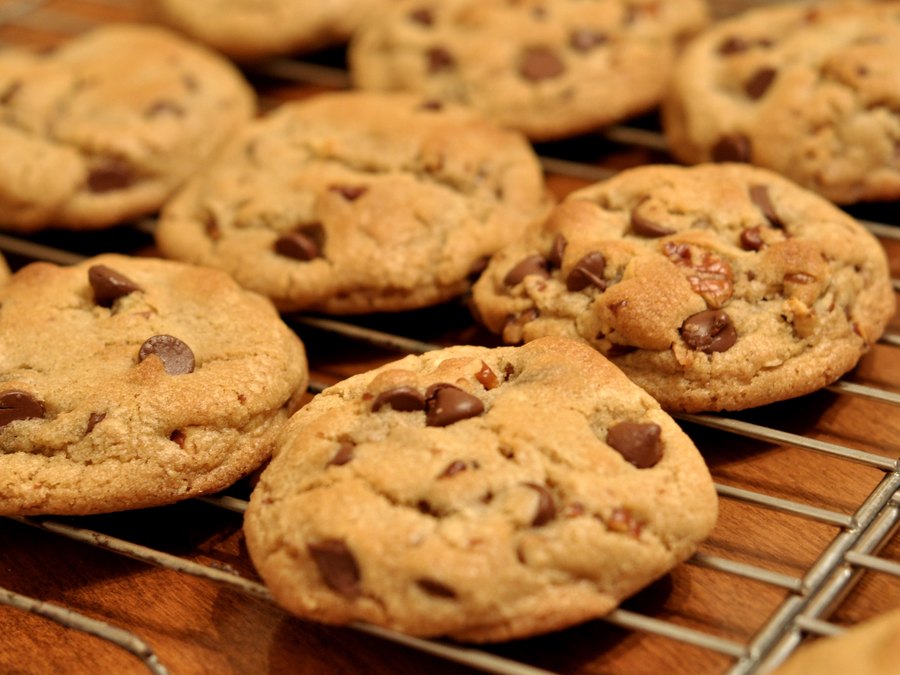
A tall, domed chocolate chip cookie that has barely spread.
pjmorse · CC BY-SA 2.0
The part nobody leads with

Thick starts as a size decision

A bigger portion of dough takes longer for the edge to dry and the centre to set, which is precisely what a bakery-style cookie needs time to do.

Average dough per cookie, by the texture group each recipe measured into, not by what the recipe calls itself.
Texture groupAverageRangeBased on
Crispy35 g20–51 g20 recipes
Chewy50 g21–74 g53 recipes
Cakey78 g26–166 g9 recipes

All five of the heaviest recipes in the whole 85-recipe set, the ones at 88 g and up, measured by texture as what our own cakey page treats as a fault: tall, soft, closer to a muffin top than a cookie. That page is right to call it a fault when it happens by accident. Read on purpose, the same physics is the whole idea of a bakery-style cookie. More mass buys more time before the middle finishes, and that is the entire trick. One of them is even titled “Thin and Crispy Chocolate Chip Cookies”: 106 g of dough, heavier than any recipe we measured as chewy. A recipe’s name is marketing. Its formula is what we compare.

Then the formula

One lever, measured

Direction and rank only. We will not tell you how thick the result will be.

  • Leavening: more of it gives you a thicker cookie. 242 bakes, compared across recipes, not tested by a baker who swapped it mid-recipe.

This pushes a cookie thicker on purpose. Whether the same axis also explains accidental puffiness on our cakey page is a claim we check there, not one we repeat here without looking again.

One popular piece of advice does not hold here. More leavening does not add height in what we measured. Across 242 bakes it moved the cookie the other way, flatter and wider. If you are chasing height, extra baking soda or powder is not where it comes from.

A number worth checking, not just quoting

Almost nobody in this corpus reaches for higher-protein flour

All 85 recipes in the corpus have a classified flour. 5 call for higher-protein bread flour and 60 use standard all-purpose; the rest, 20, use a gluten-free blend. We do not have a measured link between flour protein and how thick a cookie bakes, so treat this as a scarcity worth knowing, not a lever.

It is not a random 5, though. Every one of them is also well above the median dough weight for the whole corpus: Supersized, Super-Soft Chocolate Chip Cookies (92 g, www.kingarthurbaking.com); Chocolate Chip Cookies (71 g, iambaker.net); Sourdough Chocolate Chip Cookies Recipe (71 g, littlespoonfarm.com); Sourdough Chocolate Chip Cookies (62 g, www.kingarthurbaking.com); Ultimate Chocolate Chip Cookies (58 g, handletheheat.com). We cannot say the flour caused the size, only that in this corpus, the recipes that bother with higher-protein flour are also, every time, ones that already portion big. The Levain copycat below is the exception: it gets to 109 g on all-purpose flour and portion size alone.

Named honestly

Do we have a Levain Bakery copycat?

One recipe in the corpus, and we are not going to let its title imply more than it is.

This is a copycat, not Levain Bakery’s own recipe. Levain Bakery, the New York bakery whose name gets borrowed for every "giant cookie" search, has never published its formula. The one recipe in our corpus with “Levain” in its title is Copycat Levain Bakery Chocolate Chip Cookies, from bromabakery.com, an independent baker’s attempt to reverse-engineer the result, rated 4.8★ by 38 cooks who tried it. It portions at 109 g a cookie, close to the heaviest quarter of everything we measured, and it gets there on plain all-purpose flour. Size is doing the work, not a specialty ingredient.

If you want the New York bakery-style effect without following a copycat exactly, two other recipes in the corpus are built the same direction without claiming the name: Brown Butter Chocolate Chip Cookies from infinetaste.com (74 g, 4.63★, 1,993 cooks), and Sourdough Chocolate Chip Cookies Recipe from littlespoonfarm.com (71 g, 4.94★, 945 cooks). Both are bigger than our own chewy average, and both are trusted by far more cooks than the copycat has.
The copycat, in full

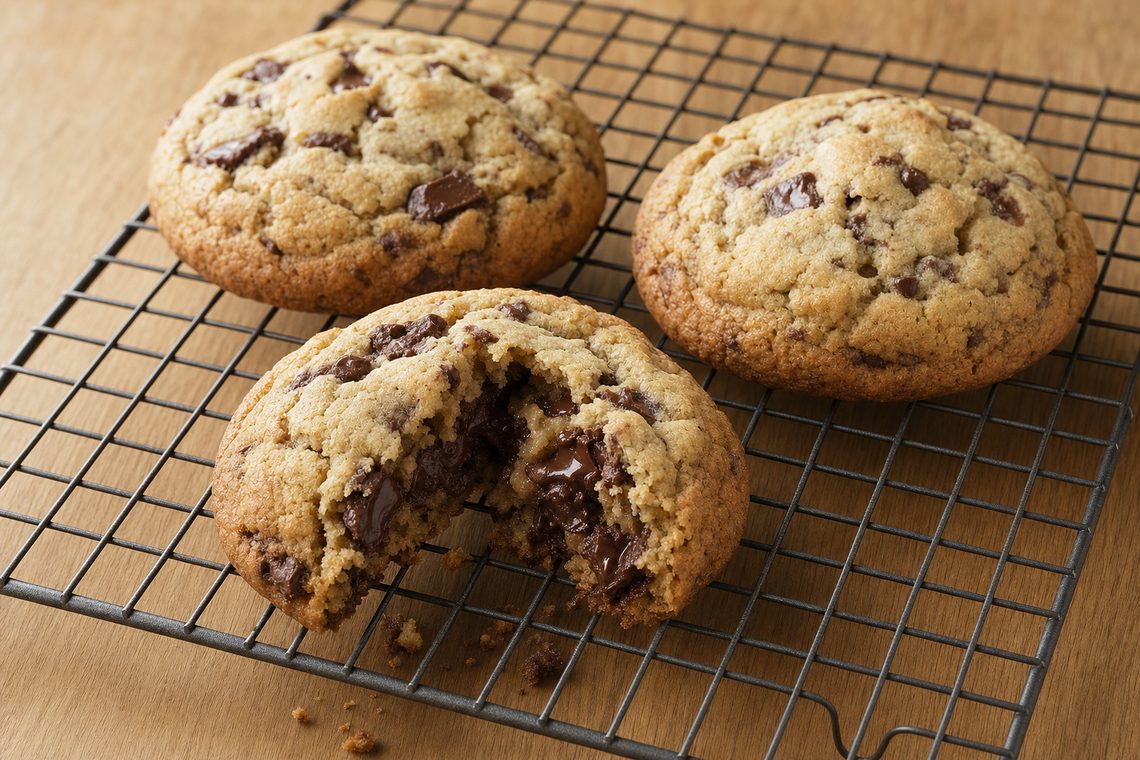
Copycat Levain Bakery Chocolate Chip Cookies

Weights beside each ingredient, where we could resolve them, are ours. The dough rests cold for hours before it bakes. That is part of how a cookie this large holds its shape.

10 minHands on
12 hrWaiting
12Makes
109 gEach
intermediateLevel

Ingredients

  • 3 cups plus 2 tablespoons all purpose flour (I used King Arthur Unbleached AP Flour)
  • 1 teaspoon baking powder
  • ¼ teaspoon baking soda
  • 1 ½ teaspoons kosher salt
  • 1 cup unsalted butter, cold and cut into cubes
  • ¾ cup + 4 teaspoons (6 ounces) light or dark brown sugar
  • ½ cup granulated sugar
  • 2 eggs, cold, lightly beaten in a separate bowl
  • 1 teaspoon vanilla extract
  • 2 cups dark chocolate chips (I used Ghirardelli dark chocolate baking chips)

Method

  1. Line a large baking sheet with a silicon mat or parchment paper. Set aside.
  2. In a medium bowl, mix together the flour, baking soda, powder, and salt. Set aside.
  3. In a standing mixer fitted with a paddle attachment, beat the butter until it comes together in one lump, about 1 minute. Add in the sugars and beat for another 1-2 minutes, or until the sugar dissolves into the butter. Lower the speed to medium-low, and mix in the eggs and vanilla and beat until mixed (the batter will be lumpy). Gradually add in the flour mixture, beating until a little flour remains. Fold in the chocolate chips with a rubber spatula.
  4. Divide the dough into 12 even pieces. Shape the dough roughly into a ball, but do not roll it. Place on the prepared baking sheet, spacing 2 inches apart. Refrigerate for at least 30 minutes but up to 12 hours before baking.
  5. Preheat oven to 375°F. Bake cookies for 15-20 minutes, until light golden brown. When in doubt, take your cookies out early. The cookies will continue to cook as they cool. There’s nothing that ruins them more than being overcooked. I can’t stress this enough! Cool on a wire rack, then serve!

This recipe is Copycat Levain Bakery Chocolate Chip Cookies by bromabakery.com. It is their work, reproduced so you can bake from one page. It is a copycat attempt, not Levain Bakery’s own recipe.

Every candidate we hold

The whole corpus, filtered to 70 g and up

Not a texture group, a plain weight cutoff, because “thick” and “giant” are size queries first. Each one is tagged with the texture group our classifier put it in, which is why most of the smaller entries here read chewy rather than cakey.

10 of the 85 recipes we compared clear 70 g. That is a thin slice on purpose. Most published chocolate chip cookies are not trying to be this big.

Honesty

What this page cannot tell you

We hold dough weight, not baked size

Every gram figure here is dough per cookie before the oven. We do not have the baked diameter or height for any recipe, so we cannot tell you how tall or how wide yours will actually come out. Your tray, your oven and how cold your dough was all move that, and none of them are in our data.

The heaviest group is also the thinnest evidence

The group with the biggest average weight, 78 g, is built on only 9 recipes with a small enough sample that one very large or very small cookie moves the average a lot. Treat the group figure as a direction, not a promise.

We do not have an ingredient lever for this

The only formula effect on spread we can measure directly is butter, and it runs the wrong way for thickness: more butter means more spread, not less. Brown sugar moves chew and edge texture, and flour protein moves how set the middle bakes up, but neither one has a measured link to how far a cookie spreads. That is why this page leans on portion size and nothing else.

One copycat is not the bakery

We hold exactly one Levain-named recipe, and it is somebody else's reverse-engineering attempt. We are not going to present it as more than that.