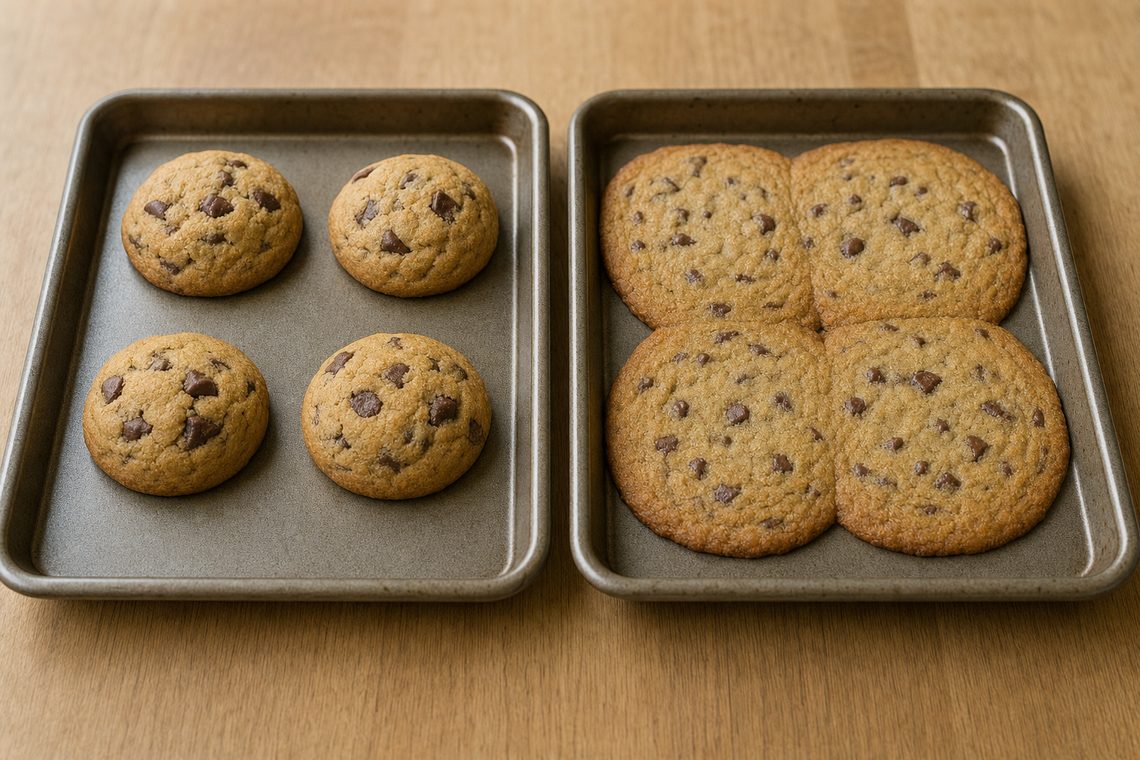
We checked. We could not measure an effect.

Does chilling cookie dough actually matter?

We looked for an effect on chew and spread. We could not find one. That is the honest answer, not a hedge.

This is the most confidently repeated instruction in the whole category, and the pages ranking for it openly disagree with each other. We hold the resting time for 84 published recipes and read 7,124 reviews, including 81 cooks telling us to chill. Here is what we checked against the data, and what came back each time.

0Effects we could confirm
84Recipes' rest compared
36Recipes rest long
13Rest not at all
Chocolate chip cookie dough resting before baking.
Kimberly Vardeman from Lubbock, TX, USA · CC-BY
Three claims, checked separately

What chilling actually does

People chill for three different reasons. None of them held up as something we could measure.

The direct answer 84 recipes

We could not fit a measured effect

Not for chew, not for spread, not for anything else we checked. Resting time never cleared as a lever in our data.

That is a real result, not a shrug. We split the corpus by how long each recipe rests, none, short or long, and compared the groups on every outcome we track. None of the usual reasons people chill dough showed up as something we could measure.

What to do: if your recipe calls for a rest, follow it. It was formulated as part of a system. If it does not, you are not missing anything we can prove.

We looked, and found nothing 84 recipes

It makes cookies chewier

We could not detect it. Resting time varies enormously across these recipes and it never lined up with how chewy the result was.

This is the claim cooks make most often in our reviews, so we want to be careful about what we are saying. Not detected is not the same as disproved: an effect smaller than the spread of these recipes would look exactly like this to us. But if chilling were the reliable chewiness lever it is described as, we would expect to see it, and we do not.

What to do: if chew is what you are after, brown sugar is the lever with evidence behind it.

A trend, not a lever 84 recipes

It stops them spreading

Partly. Recipes that rest longer do come out thinner than average, but resting never became a measured lever, so the effect is smaller and less consistent than the advice implies.

This is the honest middle that neither side of the argument occupies. King Arthur is not wrong that the direction exists. The pages calling it optional are not wrong that it will not rescue a formula. Chilling nudges. It does not fix.

What to do: if yours are spreading badly, weigh the flour and look at the butter before you reach for the fridge.

The evidence, such as it is

How the recipes group by resting time

Descriptive: these are different recipes sorted by how long they rest, not one dough rested three ways. Read it as a pattern, and note how small the pattern is.

Recipes that call forHow many Tend to come out
No rest at all13 recipesabout average
A short rest35 recipesabout average
A long rest36 recipesabout average

If chilling were the decisive factor it is usually described as, these three groups would look very different from each other. They do not. One wrinkle worth knowing: 24 of the 35 recipes we label "short" never mention chilling in their own steps. "Short" is this classifier's default for an unstated rest, not always a chosen one.

What cooks told us

The advice, in their words

We are not dismissing this. A lot of people believe chilling changes the texture, and they are the ones who baked the cookies.

Chill the dough before baking for a thicker cookie that spreads less.

24 cooks say yes · 2 say the opposite

Double the batch and freeze half the raw dough, then defrost it in the fridge overnight to bake small batches on demand.

17 cooks reported this

Chill the dough -- at least an hour, longer if you can -- for a chewier cookie.

14 cooks say yes · 1 say the opposite

Chill the dough (or let it rest in the fridge) before baking for crisper edges -- skipping the chill usually gives softer edges.

8 cooks say yes · 1 say the opposite

Chill the dough before baking, even just a few hours, to reduce spread; skipping the chill or only refrigerating briefly lets cookies spread more.

6 cooks reported this

Counts come from an earlier, smaller reading of the reviews: a floor, not a total.

So, practically

Should you chill yours tonight?

If the recipe says to, do

A recipe is a system. Its sugar, fat and flour were chosen alongside its resting time, and 71 of the recipes we compared build a rest in. Removing one part of a system that was balanced with it is a different question from whether chilling matters in the abstract.

If it does not, you are not cheating

13 recipes call for no rest at all and cooks rate them just as highly. There is a whole page on the recipes built to skip it.

If you are chasing texture, chill last

It is the lowest-yield change on the list. Flour by weight, then butter handling, then the sugar ratio, and last of all, if you still want to, the fridge.

Honesty

What this page cannot tell you

“Not detected” is not “does nothing”

An effect smaller than the variation across these recipes would be invisible to us. We are reporting the limit of what we can see, not a proof of absence.

Resting time is coarse

We know whether a recipe asks for no rest, a short one or a long one. We do not have hours, so we cannot tell you whether 24 differs from 72.