Troubleshooting

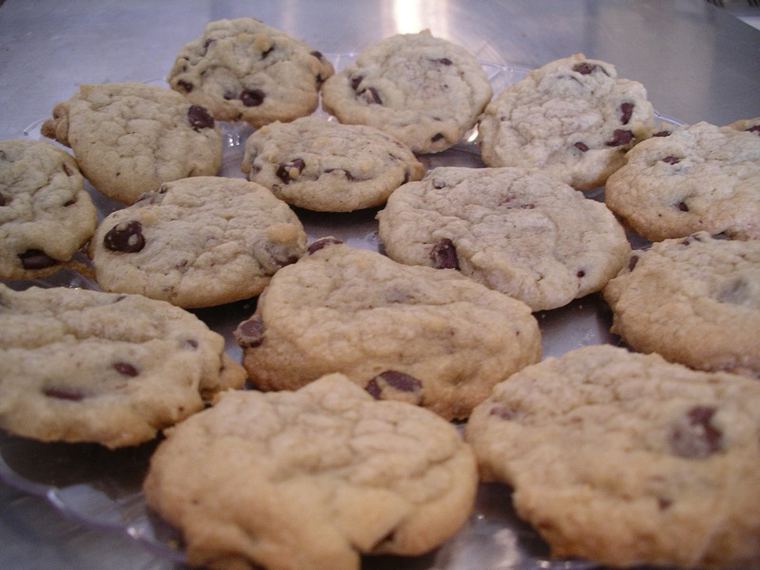
Why are my cookies cakey and puffy?

Nearly every cakey cookie is a flour problem: not the recipe's, the measuring's.

A cup scooped from the bag holds up to a third more flour than a cup spooned in and levelled, which is enough on its own to make a cookie set before it spreads. Weigh it at 120 g per cup and bake the recipe as written. Below: what to change after that, and the three fixes worth skipping.

Read against 619 published chocolate chip cookies recipes and 10,058 reports from cooks who changed one thing.

Pale, domed chocolate chip cookies that have not spread.
pjmorse · CC BY-SA 2.0
What to change

How to fix a cakey cookie

In the order we would try them.

Start here

Weigh your flour

A cup scooped straight from the bag can hold a third more flour than a cup spooned in and levelled, and that difference on its own is enough to turn a chewy cookie cakey.

This is the uncomfortable part, so we will say it kindly: the recipe is usually fine, and the measuring is not. Nobody gets it wrong on purpose. Scooping packs the flour down, the same cup line gives you a different cookie on different days, and flour is the ingredient a cookie is least forgiving about. A scale removes the whole variable. Set it to 120 g per cup and bake the recipe you already have before you change anything in it.

Honest note: recipes record what they asked for, never what went into your bowl, so this is the one cause we cannot put a number on. We are still putting it first, because it is still the most likely one.

Skip this one 18 bakes

Do not cut the baking soda

Cutting the leavening is the most repeated advice for a puffy cookie, and the cooks we read got the opposite result: more leavening made cookies spread flatter, not taller.

Leavening does two jobs at once. It lifts, and it shifts the dough toward alkaline, which weakens the structure that would have held that lift up. The rise you get early is paid back by a softer set later. Adjusting it moves your cookie in the direction you did not want, and not very far.

From 18 bakes where a cook changed the leavening and nothing else, and told us what came out.

Not the cause

Leave the eggs alone

Egg varies a lot across these recipes, and none of that variation showed up as a difference in spread.

Egg has a real job in a cookie: it firms the middle and browns the surface sooner. It is simply not the thing that decides how far the dough travels on the tray. Pulling an egg to fix puffiness costs you texture and does not buy you spread. Add a yolk if you want a richer cookie, but make that a flavour decision, not a repair.

Open question 27 of 619 use powder alone

If your recipe says soda, use soda

Several sites blame baking powder for cakey cookies, but almost no published recipe uses powder on its own, so there is nothing to compare it against.

Of the 619 recipes we resolved, 27 use baking powder on its own, which is not enough to compare against anything. The idea is reasonable, since powder brings its own acid and behaves differently in the dough. But reasonable is not the same as tested, and we would rather tell you that than dress a guess up as a finding.
Tonight, with dough you already have

Flatten the ball before it bakes

Shaping moves thickness faster than any ingredient, it works on dough already in the fridge, and it is the one thing cooks do not argue about.

Level off your quarter-cup scoops and don't reshape the dough once it's on the sheet -- it spreads a bit more evenly.

9 cooks reported this

Portion size affects spread, but reports disagree on the direction: some find smaller scoops spread more while a full, well-packed quarter-cup holds its shape, others find the opposite, with larger scoops spreading either more or proportionally less.

5 cooks reported this

Handling the dough a lot and letting it warm up before baking makes it spread more. Portion size on its own is less reliable: bigger dough balls sometimes spread more from the extra weight, and sometimes spread less because a denser, colder mass holds its shape.

3 cooks reported this

Baking thicker portions, oversized dough scoops, a deep pie plate, or a 9x13 pan instead of individual cookies, leaves the centers gooier since they don't cook through as evenly.

3 cooks reported this

Why it happens

Why a cookie comes out cakey

The dough spreads while its fat is liquid and stops when its structure sets. Anything that brings the setting forward, or slows the spreading, leaves you a taller, softer, more cake-like cookie.

Gluten development

Flour protein plus available water plus agitation builds an elastic network that resists the bite.

Sugar-water competition

Sugar is hygroscopic in the dough too. It binds water and denies it to the flour, suppressing gluten.

Leavening and dough pH

Baking soda does two jobs: it makes CO2 with an acid, and it raises pH. Above about pH 8 the Maillard reaction speeds up sharply; below 7.8 it stalls and cookies stay pale.

Bake geometry

Mass and surface-to-volume decide how far the edge dries before the centre sets. Edge and centre are separately controllable, which is why a cookie can be crisp outside and soft inside without contradiction.

Straight with you

Where we would be guessing

So you know how far to trust the rest of this page.

Why the flour advice comes with no number

Recipes record what they asked for, not what you poured. That is why the flour advice above comes with a scale rather than a statistic, and why we put it first anyway.

Powder-only recipes barely exist

27 of 619 recipes use baking powder on its own, so the powder-versus-soda question has nothing to compare against. Not disproved, just never tested.

We can tell you direction, not dose

We can say which way a change pushes your cookie and which changes push hardest. We cannot tell you how tall yours will come out, because that also depends on your oven, your butter, and the day.