A measured lever
5 bakes
More egg → gooier in the middle
Recipes with more egg in the dough come out gooier in the middle. More egg sets the crumb sooner, so the middle finishes firmer and holds its shape.
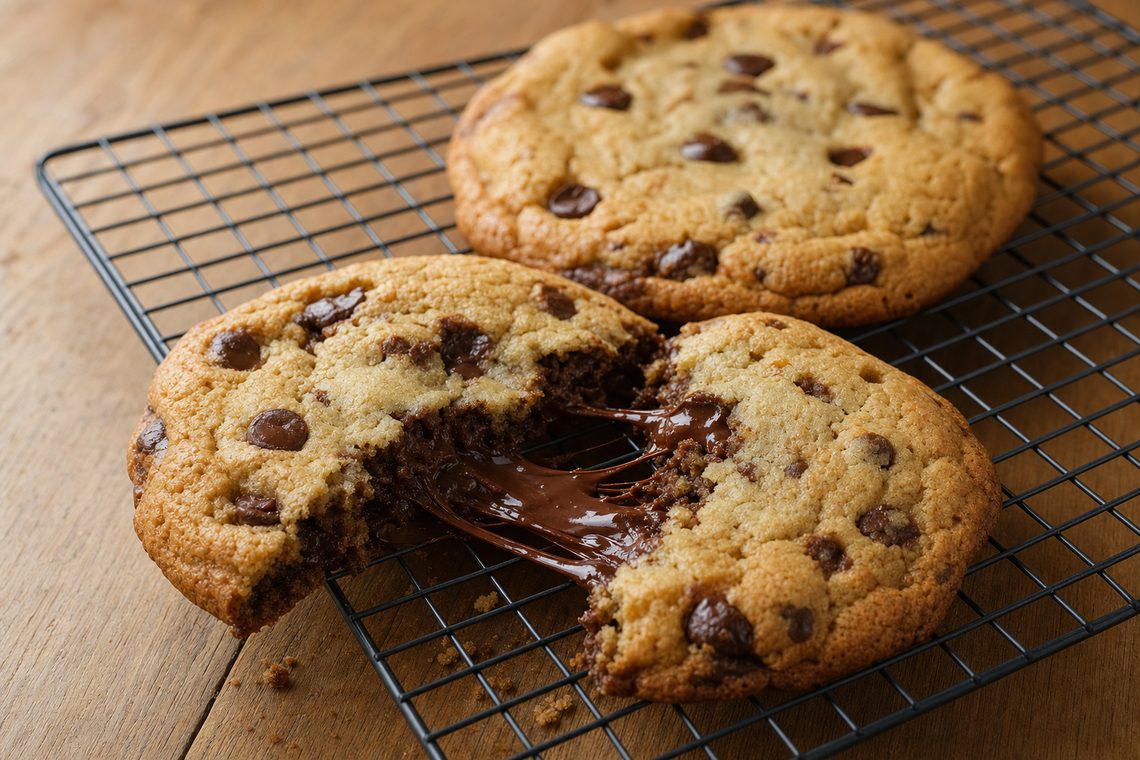
Bake to the edges, not the middle. A big cookie is supposed to look wet in the centre when its edge is set, and it finishes on the tray after you pull it.
This is a geometry problem, not a timing one. The cookies in the recipes we compared run from 20 g to 166 g of dough, and edge and centre are decided by different physics, so the gap between them widens as the cookie gets bigger. Below: what to look at instead of the clock.
Read against 619 published chocolate chip cookies recipes and 10,058 reports from cooks who changed one thing.
A minute count or a degree. We hold no structured oven temperatures or bake times, only whatever a recipe's own author happened to write in their method text, and those recipes disagree with each other on both. Anyone selling you one number for every cookie is guessing at the size of your dough ball. Use the visual cues below instead, or start from the wider troubleshooting hub if the problem is really spread, not doneness.
Mass and surface-to-volume decide how far the edge dries before the centre sets. Edge and centre are separately controllable — which is why a cookie can be crisp outside and soft inside without contradiction.
We have a weighed cookie for 82 of the 619 recipes we compared. The smallest finished cookie in that set is 20 g; the heaviest is 166 g. Between those two, 16 recipes land under 35 g and 19 sit over 60 g, 10 of those over 70 g. A typical cookie in our corpus runs close to 46 g, and the middle half sit roughly between 36 g and 58 g.
Cookie mass never turned into one of the two fitted levers below. Not because the effect is not real, it is basic physics, but because our reviews compare cooks who changed the egg or the butter and told us what happened, not cooks who ran a controlled test on how many grams of dough they scooped. The mechanism is universal even where we have no fitted vector to point at. It is also why edge and centre can be judged separately without contradiction: they are set by different physics, running on different timers, inside the same cookie.
These hold across recipes of every size, so they stack with the geometry above rather than replacing it.
Recipes with more egg in the dough come out gooier in the middle. More egg sets the crumb sooner, so the middle finishes firmer and holds its shape.
Recipes with more added liquid in the dough come out more set in the middle. More added liquid builds more gluten, so the cookie pulls when you bite it instead of crumbling.
Not a defect. The whole point of a bakery-style cookie is this exact contrast, deliberately exploited rather than avoided.
This is not a fringe case: 19 of the recipes we compared build a cookie over 60 g, 10 of those over 70 g, against 16 recipes under 35 g. If the last cookie you baked was on the heavier side of that split and you judged it against a memory of a smaller one, the comparison was never fair to begin with. If you want the big, deliberately-underdone-looking centre on purpose, that is what a bakery-style cookie is built to do. It leans into this same gap rather than fighting it.
These are quotes from recipes' own method text, not our recommendation. Read them together and you can see why we did not fit one.
Double the batch and freeze half the raw dough, then defrost it in the fridge overnight to bake small batches on demand.
17 cooks reported this
Chilling the dough before baking crisps up the edges, and skipping the chill usually gives softer edges. For a pan-banging cookie specifically, dough chilled solid won't ripple properly and needs to come back to room temperature first.
9 cooks reported this
Level off your quarter-cup scoops and don't reshape the dough once it's on the sheet -- it spreads a bit more evenly.
9 cooks reported this
Adding more flour relative to butter reduces spread: a ratio near 1-to-1 flour to butter gives wafer-thin, widely spread cookies, while 1.3-to-1 or higher barely spreads and stays dense in the center, with around 1.25-to-1 landing in between. Results aren't universal, though - one baker still saw more spread despite extra flour.
9 cooks reported this
Pull the cookies out a couple minutes early -- cutting the bake time from about 12 minutes to 10 -- for a chewier texture.
8 cooks reported this
Bake a few minutes longer, or a bit hotter, for deeper browning.
7 cooks reported this
Two of the recipes quoted above chill the dough for opposite stated reasons: one says it is for a thicker cookie that spreads less, another says it is for chew. Both are right for the recipe they belong to. That is exactly why a bake time or a chilling step lifted from any one recipe's method text is a fact about that recipe, not a rule about cookies, and exactly why size, not the clock, is the variable that actually generalises.
Refrigerate the dough for about an hour and let the cookies finish setting on the hot baking sheet after they come out of the oven, for deeper, more golden-brown color. 6 cooks mentioned this. The cookie keeps cooking on a hot tray after the oven door opens, which is part of why a centre that looks slightly underset the instant you pull it is often exactly where you want it.
So you know how far to trust the rest of this page.
Oven temperatures and bake times sit in each recipe's own method text, not in a field we fitted the way we fitted sugar or butter. Averaging recipes that disagree by 25 degrees would manufacture confidence rather than earn it, so we give you cues you can see instead of a number you cannot check.
A bigger portion keeps its centre underdone while the edge sets, widening the gap between the two. That mechanism is basic geometry and we are confident in it, but it never became one of the two measured levers above, because nobody in our reviews changed only the dough-ball size and told us what happened.
Oven calibration, tray colour, whether you baked one sheet or two, all move how the edge and the centre set, and none of them are in our data. That is the case for visual cues: they survive all of it, and a minute count does not.