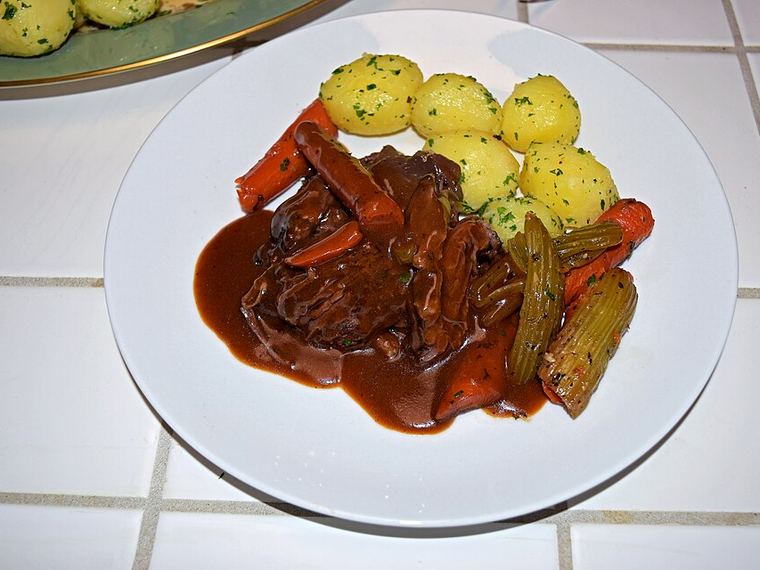
Compared by formula

Pot Roast

194 recipes, read so you don't have to.

Every recipe is a different answer to the same few questions. Tell us the pot roast you are after and we will hand you the closest one anyone has published, plus what to change to suit you.

194recipes read
5recipes, not one
10problems solved
Pot Roast, as published.
Mark Miller Β· CC BY-SA 4.0
Start here

What kind of pot roast do you want?

Five real versions, not one "best." Pick one and the recipe's right here β€” a published, rated one, with weights.

Any limits tonight?
Closest published match Β· of 85 dutch oven recipes

Dutch oven, the Sunday version

One pot, one afternoon. Beef, carrots, potatoes and a gravy made from the pan.

from www.thepioneerwoman.com 4.76 67 cooks rated it

20 minHands on
10Makes
$3.12Each
BeginnerLevel

Ingredients

  • 4 to 5 lb. whole chuck roast2041 g
  • Kosher salt and pepper, to taste
  • 2 tbsp. olive oil, plus more as needed27 g
  • 2 whole onions300 g
  • 6 to 8 whole carrots427 g
  • 1 c. red wine (optional, you can use beef stock instead)236 g
  • 2 to 3 c. beef stock600 g
  • 3 sprigs fresh rosemary, or more to taste3 g
  • 3 sprigs fresh thyme, or more to taste3 g
  • 2 tbsp. tomato paste (optional)33 g

Method

  1. First and foremost, choose a nicely marbled piece of meat. This will enhance the flavor of your pot roast like nothing else. Generously salt and pepper your chuck roast.
  2. Preheat the oven to 275˚F. Heat a large pot or Dutch oven over medium-high heat. Then, add the olive oil (or you can do half butter, half olive oil).
  3. Cut the onions in half and cut the carrots into 2-inch slices. When the oil in the pot is very hot (but not smoking), add in the onions, browning them on one side and then the other. Remove the onions to a plate.
  4. Throw the carrots into the same very hot pan and toss them around a bit until slightly browned, about a minute or so.
  5. If needed, add a bit more olive oil to the very hot pan. Place the meat in the pan and sear it for about a minute on all sides, until it is nice and brown all over. Remove the roast to a plate.
  6. With the burner still on high, use either red wine or beef stock (about 1 cup) to deglaze the pan, scraping the bottom with a whisk to get all of that wonderful flavor up.
  7. When the bottom of the pan is sufficiently deglazed, place the roast back into the pan and add enough of the beef stock to cover the meat halfway. Add in the onion, carrots, rosemary sprigs, and thyme sprigs. Add tomato paste if using (it makes the liquid a little richer.)
  8. Put the lid on, then roast in the oven for 3 hours (for a 3-pound roast). For a 4- to 5-pound roast, plan on 4 hours.

Watch out for: Not tender at hour four is UNDERcooked, not overcooked β€” keep going; the 32-cook fix. Judge by fork and thermometer, never by clock.

Closest published match Β· of 76 slow cooker recipes

Mississippi pot roast, made less salty

Butter, two seasoning packets and a jar of pepperoncini, with the salt dialled back so it is edible.

from belleofthekitchen.com 4.97 2,628 cooks rated it

5 minHands on
8Makes
$2.64Each
BeginnerLevel

Ingredients

  • 1 (3-4 pounds) chuck roast1588 g
  • 1 packet ranch dressing mix
  • 1 packet au jus gravy mix
  • 1/4 cup butter57 g
  • 4-5 pepperoncini peppers

Method

  1. Place roast in the slow cooker and sprinkle the top with the ranch dressing mix and the au jus mix. Place peppers on top of the mixes, and add the butter.
  2. Cook over low heat for 8 hours. Serve with noodles, rice or mashed potatoes. Enjoy!

Watch out for: Slow cookers vary by model and age enough that one machine's low is another's simmer β€” 4 cooks found the same roast tough in one cooker and tender in another. First run: check early.

Closest published match Β· of 27 pressure cooker recipes

Pressure cooker, ready in 90 minutes

Tender, and a little drier than the slow versions. That is the trade for the time.

from www.thereciperebel.com 4.94 496 cooks rated it

15 minHands on
40 minWaiting
8Makes
$2.66Each
IntermediateLevel

Ingredients

  • 2 teaspoons seasoning salt (I use Lawry's)12 g
  • 1 teaspoon garlic powder3 g
  • 1 teaspoon dried parsley2 g
  • Β½ teaspoon onion powder2 g
  • Β½ teaspoon black pepper1 g
  • 3 lb beef chuck roast (cut into 1lb chunks)1361 g
  • 2 tablespoons canola oil27 g
  • 1 medium onion (finely chopped)150 g
  • 3 garlic cloves (finely minced)9 g
  • 2 cups low sodium beef broth480 g
  • 3 tablespoons balsamic vinegar45 g
  • 2 tablespoons tomato paste33 g
  • 2 tablespoons Worcestershire sauce32 g
  • 1 Β½ lb Creamer potatoes ((or baby potatoes) whole)680 g
  • 3 large carrots (peeled and cut into thick slices)183 g
  • 1 tablespoon ketchup (or honey)17 g
  • 2 tablespoons corn starch19 g
  • 2 tablespoons water30 g

Method

  1. In a small bowl, combine seasoning salt, garlic, parsley, onion powder and pepper. Sprinkle over roast to season.
  2. Turn Instant Pot to saute. When it reads hot, add the oil and sear roast on all sides. To do this, place the roast in the pot and do not move for 2-3 minutes. When you flip it, it should release from the pan easily. You may need to add extra oil to brown all of the pieces and cook them in 2 batches. When browned, removed the meat from the Instant Pot.
  3. Add the onion and cook, stirring, until softened (adding more oil if necessary). Add the garlic and cook 1 minute.
  4. To the Instant Pot add broth, vinegar, tomato paste, and Worcestershire sauce -- if there are brown bits stuck to the bottom from the meat, give them a scrape with a wooden spoon and they should release easily -- this will help to prevent a burn message. Stir to combine.
  5. Add the meat back into the pot. Put the lid on and turn the valve to sealing. Select Manual or Pressure Cook and set the cook time for 65 minutes on high pressure (90-100 minutes for a frozen roast).
  6. When the cook time is over, turn the Instant Pot off and let the pressure release naturally (this should take 10-15 minutes) before turning the valve to venting and opening the lid.
  7. Remove the roast to a plate, cover and let rest for 10 minutes. Add the potatoes and carrots, put the lid back on, turn the valve to sealing and select Manual or Pressure Cook for 3 minutes.
  8. While the potatoes and carrots cook, shred the beef and keep warm.
  9. When the cook time is over, let pressure release naturally for 5 minutes before moving the valve to venting, gradually releasing remaining pressure and opening the lid.
  10. Remove potatoes and carrots from Instant Pot and place on a platter with the beef.
  11. Stir in ketchup (it's not necessary but as a nice brightness and contrast to the savory flavor of the beef). Whisk together corn starch and water and stir into gravy.
  12. Turn Instant Pot to saute and cook, stirring often, until gravy has thickened. Serve with roast beef and vegetables.

Watch out for: No reduction and no crust happen in the pot β€” sear on saute if flavor matters tonight, and finish the sauce with the lid off.

Closest published match Β· of 85 dutch oven recipes

Braised in a bottle of red wine

A whole bottle of red wine, cooked down into the sauce. Fewer vegetables, much richer gravy.

from dinnerthendessert.com 5 28 cooks rated it

10 minHands on
10Makes
$3.12Each
BeginnerLevel

Ingredients

  • 4-5 pound chuck roast2041 g
  • 2 tablespoons canola oil27 g
  • 2 teaspoons Kosher salt8 g
  • 1 teaspoon coarse ground black pepper2 g
  • 1 teaspoon dried thyme2 g
  • 1 yellow onion (diced)150 g
  • 2 cloves garlic minced6 g
  • 1/4 cup tomato paste66 g
  • 2 cups beef broth480 g
  • 2 cups red wine472 g

Method

  1. Preheat the oven to 325 degrees and season the chuck roast with the Kosher salt, pepper and thyme and add to a large dutch oven with the canola oil on medium heat.
  2. Brown the meat on all sides (3-4 minutes on each side) then remove from the pot.
  3. Add the onions and garlic cooking for 1 minute, stirring frequently before adding in the tomato paste and cooking for 1 more minute, stirring well.
  4. Add in the beef broth, red wine and the roast, cover and cook in the oven for 3-4 hours until fork tender.

Watch out for: Season at the very end, after all reduction β€” and taste the wine before it goes in; an hour of concentration amplifies flaws as faithfully as virtues.

Closest published match Β· of 85 dutch oven recipes

Cooked the day before

Better on day two, and the fat lifts off the cold sauce in one sheet.

from thestayathomechef.com 4.86 96 cooks rated it

15 minHands on
8Makes
$3.75Each
BeginnerLevel

Ingredients

  • 3 to 5 pounds beef roast (chuck, round, or brisket)1814 g
  • 2 teaspoons salt12 g
  • 1 teaspoon black pepper2 g
  • 2 tablespoons vegetable oil27 g
  • 6 cloves minced garlic18 g
  • 1 to 2 cups red wine*354 g
  • 2 cups beef broth480 g
  • 1/4 cup Worcestershire sauce64 g
  • 2 large white onion (cut into 2 inch chunks)300 g
  • 1 pound baby carrots454 g
  • 1 pound red potatoes (cut into bite-sized chunks)454 g
  • 1 sprig fresh rosemary1 g

Method

  1. Heat oven to 350℉ (175℃). Place a large oven-safe Dutch oven over high heat.
  2. Pat 3 to 5 pounds beef roast dry with paper towels. Season both sides with 2 teaspoons salt and 1 teaspoon black pepper. Add 2 tablespoons vegetable oil to the hot Dutch oven. Sear the roast until browned, about 3 to 4 minutes per side. Remove the roast and set aside on a plate or cutting board.
  3. Reduce heat to medium. Add 6 cloves minced garlic, minced, and cook for 60 seconds, stirring constantly. Deglaze the pan by adding 1 to 2 cups red wine* and 2 cups beef broth, scraping up any browned bits from the bottom.
  4. Pour Worcetershire sauce over roast and place the onion chunks, carrots, and potatoes on top of and around the meat. Place rosemary sprig on top.
  5. Return the roast to the pot. Pour 1/4 cup Worcestershire sauce over the meat. Arrange 2 large white onion, cut into 2-inch chunks, 1 pound baby carrots and 1 pound red potatoes, cut into bite-sized chunks around and on top of the roast. Place 1 sprig fresh rosemary on top.
  6. Place a lid on the pan and transfer it to the preheated oven. Cook 3 hours, or until meat reaches an internal temperature of 202 degrees F and shreds easily with a fork.
  7. Remove from oven. Taste and season the vegetables with additional salt and black pepper, if desired. Serve hot with the shredded roast and pan juices.

Watch out for: One safety note from the file: never blend or strain the braising liquid at full boil β€” a cook documented the eruption.

Need it to fit something tonight β€” no wine or beer, no dairy, under 20 min hands-on? Those re-pick the recipe once JavaScript is on. With it off, you still get all 5 recipes above in full.

Why pot roast comes out tough, or dry

Two things happen at once inside the meat. Tough connective tissue slowly melts into gelatin, which is what turns a $12 piece of chuck silky. At the same time the muscle fibres tighten and squeeze out water, which dries it.

Tenderness goes up while juiciness goes down, and every pot roast is a bet on where they cross. That is why this dish's signature failure is the strange one β€” falling apart AND dry at the same time. And it is why the most useful number here is a temperature, not a time: pull at 195 to 205Β°F, when the connective tissue has given up. Pulling at 160Β°F is the worst of both worlds, the meat at its toughest with the moisture already gone.

The cut

The bet is rigged before you turn the oven on. Chuck has the connective tissue and the fat to forgive almost anything. Round is lean and tight, and it is the usual reason a pot roast comes out dry no matter what else you did.

Time and temperature

Buys tenderness, costs moisture, and the exchange rate depends entirely on how hard you are cooking. A bare simmer β€” 180 to 190Β°F in the pot, no visible bubbling β€” is where the trade goes in your favour.

The vessel

Not a convenience question. An open oven braise concentrates the liquid into a sauce while the meat above the waterline keeps browning. A sealed slow cooker reduces nothing at all, which is why its gravy is thin and why it needs two to three times the seasoning.

Three things decide it. Every change on this page works by moving one of them.

What it costs

Pot roast: what each choice costs you

You cannot have all of it at once. These are the five real trades. Knowing which one you are making is most of the skill.

Falling apart, or still juicy

This is the one you referee rather than set. Both clocks β€” the one making the meat tender and the one drying it out β€” speed up together with heat, so there is no setting where they both work for you. There is only a temperature where the good one runs ahead: a bare simmer, an oven around 300Β°F, and a cut with enough connective tissue to be worth converting. The pressure cooker shows you the failure in pure form β€” it converts fast at 250Β°F, but it tightens the fibres harder, and you get tender yet dry.

Dinner in ninety minutes, or a Sunday afternoon

Every vessel is a position on this line with a bill attached. The pressure cooker gets there in 40 to 60 minutes and gives you no reduction and no browning. The slow cooker is convenience itself, and seven cooks who moved the same recipe to a Dutch oven called the difference unmistakable β€” while four found the identical roast tough in one machine and tender in another. The honest note the crowd adds: ten cooks say any vessel gives you an acceptable roast. This axis buys refinement, not rescue.

A real gravy, or walk-away cooking

The braising liquid only becomes gravy if something concentrates it, and that means either a lid that is off or ajar during the cook, or work afterwards β€” strain it and simmer it down. A sealed pot skips that physics entirely: the liquid comes out exactly as watery as it went in. The fixes cooks report, in order of how many cooks back them: a cornstarch slurry stirred in after cooking (46 β€” the biggest single instruction in this dish), pureeing the cooked vegetables back into the liquid, and gelatin, which adds body without clouding the flavour.

Seared depth, or dump it in and walk away

Searing does not seal in juices. That was tested and it is dead, which actually frees the decision up: sear because you want the flavour, or skip it because you do not, and know that the tenderness will be the same either way. Ten cooks sear faithfully for the colour and the browned bits; two skipped it and reported no penalty. If you do it, sear the roast whole or as three thick steaks rather than cubes β€” cubes crowd the pan, steam, and overcook.

Deeply seasoned, or a salt bomb

This dish concentrates salt twice over, and the two vessels fail in opposite directions. In an open braise, reducing the liquid removes water but not sodium β€” season it fully at the start and you have seasoned the reduction, not the sauce. In the packet styles the sources stack: bouillon plus au jus mix plus ranch mix plus salted butter, each reasonable alone and inedible together (four cooks documented exactly that; six more run low-sodium everything on purpose). The slow cooker inverts it β€” nothing reduces, so it under-seasons and wants two to three times as much. One rule survives both: salt the meat properly up front, then season the sauce at the very end.

Change your pot roast recipe

Each one is measured across all 194 recipes and then converted into this recipe's own amounts. Every edit costs something. The cost is on the card.

Make it thinner Β· less salty

–

More braising liquid went with recipes that came out less salty, across 127 versions. An open braise evaporates and concentrates; a sealed one does not. That single difference is most of what separates a Dutch oven from a slow cooker.

Costs you: Nothing else moved that we can measure. We only detect 7 of the 60 changes cooks describe, so read that as unmeasured rather than free.

measured, on a smaller set Β· 127 versions

Make it hotter

–

More aromatics went with recipes that came out hotter, across 36 versions. Fat- and water-soluble compounds extract at different rates, and volatile herb compounds DEGRADE over a long cook. Eight hours destroys dried thyme.

Costs you: Nothing else moved that we can measure. We only detect 7 of the 60 changes cooks describe, so read that as unmeasured rather than free.

thin evidence β€” treat as a hint Β· 36 versions

Make it thicker

–

More thickener went with recipes that came out thicker, across 31 versions. Dissolved collagen thickens the liquid on its own. A sauce that sets to a wobble when chilled had enough; one that stays watery did not.

Costs you: Nothing else moved that we can measure. We only detect 7 of the 60 changes cooks describe, so read that as unmeasured rather than free. Another way: more vegetables.

thin evidence β€” treat as a hint Β· 31 versions

Common pot roast problems, and how to fix them

The 10 problems cooks actually report, and what to do about each one. Open the one that sounds like yours.

The meat

It is not fork-tender and the time is up

Put it back. This is the most-supported fix in the whole dish β€” 32 cooks β€” and it is the one that feels wrong, because everything you know about meat says tough means overcooked. In a braise it means the opposite: the connective tissue has not finished converting yet. Give it another 30 to 60 minutes at the same temperature, then check again. Do not raise the heat, and do not add liquid.

It shreds easily but it tastes dry

That is this dish's signature failure and it is the pressure cooker's in particular β€” the fibres got squeezed harder than the connective tissue got softened. Tonight: shred it into the sauce, thicken the sauce, and serve it wet. Next time, trade the speed back β€” lower and slower, or a fattier piece of chuck.

It came out pale and tastes flat

Nothing can fix that partway through β€” a sealed pot cannot brown anything, and the moment for a sear has passed. What you can do is reduce the sauce hard in a wide pan afterwards, which buys back some depth. Next time, sear it. And know that the tenderness was never the thing you were missing.

The sauce

The gravy is thin

Strain the liquid and stir in a cornstarch slurry β€” two tablespoons slaked in cold water, off the heat, then brought back to a simmer. 46 cooks, which makes it the single most-supported instruction in this dish. If you would rather not use starch, blend the spent vegetables into it instead. What you should NOT do is use less liquid next time: 14 cooks tried that against 5 who thought it helped, and the volume was never the problem.

The gravy is greasy

If you have time, chill it and lift the set fat off in one sheet β€” nothing else is close for reliability. If you do not, use a separator, or drag a folded paper towel across the surface. And halve the butter next time; nine cooks proved the amount these recipes ask for was never doing anything.

My slow-cooker version is watery and tastes of nothing

That is physics, not a mistake you made. Nothing evaporates in a sealed pot, so the liquid ends as dilute as it started and the seasoning never concentrates. Two fixes, both after the fact: season two to three times harder than you think, or season at the end, and finish the sauce in a wide pan on the stove with the lid off.

I used a lot of wine and the sauce is thin

Wine cannot thicken anything β€” it has no starch and no gelatin of its own, so a braise built on it has to get body from somewhere else. Use a gelatin-rich stock, reduce for longer than feels necessary, or finish with a small slurry. Next time, reduce the wine in the pot BEFORE the stock goes in, which concentrates it instead of diluting it.

Everything else

The carrots and potatoes turned to mush

They went in too early. The onion, garlic and celery belong in from the start β€” their job is to dissolve into the sauce. The vegetables you actually want to eat go in for the last 45 to 60 minutes only. If you want both a deeply flavoured sauce and vegetables with shape, cook two batches: one for the pot, one for the plate.

It is far too salty

You stacked sodium without meaning to β€” bouillon and a packet and salted butter each add their own, and nobody counts them together. Tonight, dilute with unsalted stock and re-thicken. Next time: low-sodium liquids, half a packet instead of a whole one, unsalted butter, and season only at the end once the reducing is done.

I need to cook two of these

Split them across two pots. One Dutch oven will not hold two roasts without crowding them, and crowded meat steams instead of browning. Time by how thick the pieces are, not by the total weight β€” two 3 lb roasts are not one 6 lb roast. Keep the vegetables to whatever fits under the lid, and double the gravy.

What we do not know about pot roast

Where our evidence is thin, so you know which parts of this page to lean on and which to treat as a starting point.

Our numbers are hints, not proof

The statistics found one usable signal in this whole dish, and the tool failed its own sanity check on salt. Everything here rests on mechanism and on counting what cooks reported.

Slow-cooker advice does not travel

Machines vary enough that "low for eight hours" is a different experiment in every kitchen β€” four cooks found the same roast tough in one and tender in another. Check yours early the first time.

Nobody knows whether acid tenderises anything

Three cooks mention wine or vinegar, all about flavour, none about texture. Anyone telling you confidently that wine tenderises a braise is going past the evidence.