The texture everyone wants

Soft & chewy oatmeal cookies

Push the brown sugar up. It is the one change that reliably buys chew in this dough, and it will also make the cookie spread wider, which is the half nobody tells you.

120 of the 187 recipes we compared land in the chewy group, so this is the dish's centre of gravity rather than a niche. Below: the lever, what it costs, and the popular advice that moves softness rather than chew.

Read against 187 published oatmeal cookies recipes and 2,628 reports from cooks who changed one thing.

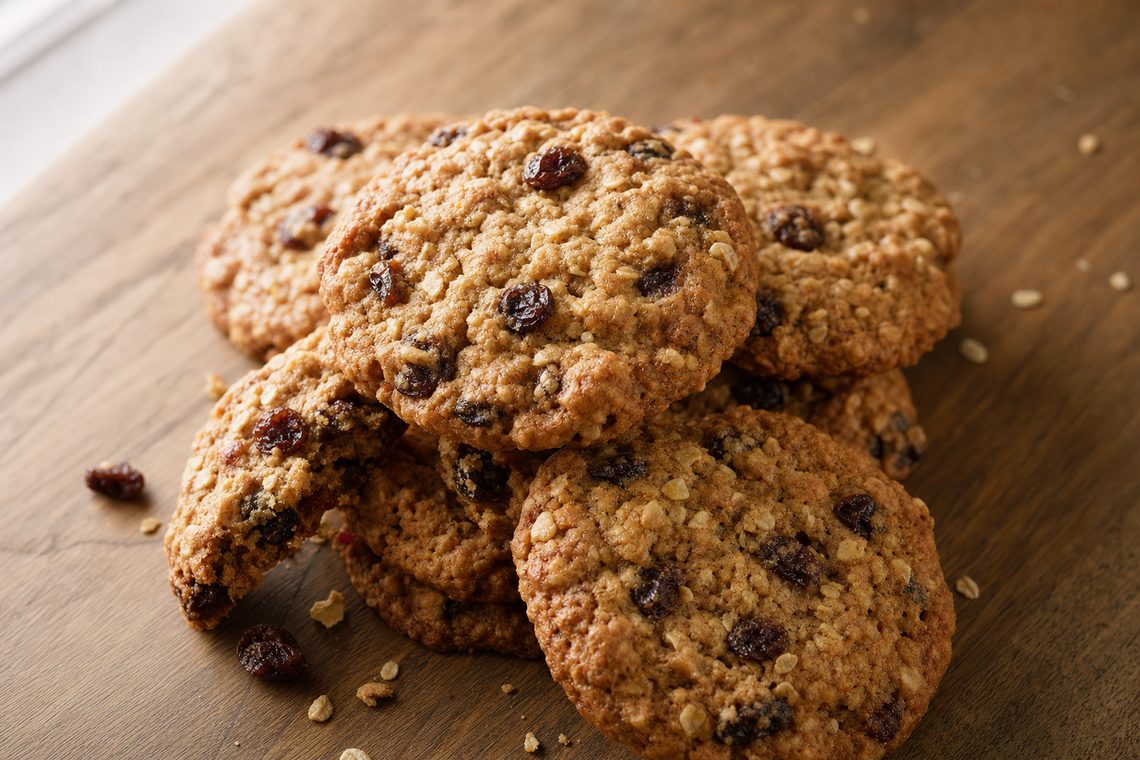
Soft, thick oatmeal cookies with a dense chewy interior.
Grammy's Kitchen · illustration
What actually moves chew

How to make oatmeal cookies chewier

The lever, its cost, and the advice aimed at the wrong thing.

Start here 318 bakes

Push the brown-to-white sugar ratio up

Of everything people suggest for a chewier oatmeal cookie, this is the one our data actually supports, and it is the best-evidenced lever on the dish.

Brown sugar carries molasses, molasses holds on to water, and water still in the crumb after baking is what chew physically is. Going all-brown is the strongest version of the change. It is also the most common thing cooks adjust here, which is why we can see it so clearly.

From 318 bakes where a cook moved the sugar ratio and told us what came out.

The cost 46 bakes

Expect a wider cookie, and stop flattening it

The same brown sugar that buys you chew is this dough's strongest push toward a flatter, wider cookie.

That is a real trade and it is the reason people chase chew and end up with a puddle. The compensation is free: leave the dough in tall rough balls instead of pressing them down. Cooks who did that kept the spread in check, and it costs nothing in the bowl. If yours are still going wide, the spread page works through the rest in order.

From 46 bakes. Fewer than the chew result rests on, so treat the direction as solid and the size as approximate.

Also holds 318 bakes

Do not cut the total sugar

Sugar holds water too, so taking it out costs you chew alongside sweetness.

The effect is real and much smaller than the brown-to-white ratio, so this is a thing to avoid doing rather than a lever to pull. If you want it less sweet without losing the texture, that is a flavour problem to solve with salt rather than by cutting the sugar.

Not for chew

Quick oats make them softer, not chewier

This is the other half of the advice you will be given, and it is aimed at the wrong outcome.

Quick oats are cut smaller and rolled thinner, so they drink water faster and vanish further into the dough. Cooks who swapped them in reported a measurably softer edge and a smoother cookie, with nobody reporting the opposite. Soft and chewy are not the same texture: chew is the crumb pushing back, and a quick oat gives you less to push against. Use rolled oats if chew is the goal.

Which one you want: the oats page walks the whole ladder, from steel-cut down to oat flour.
The pick

The chewiest recipe worth baking

Closest to the middle of the 120 recipes we measured as chewy, among those enough cooks have rated.

Oatmeal Raisin Cookies
Best of the 120 chewy recipes

Oatmeal Raisin Cookies

from natashaskitchen.com 4.95 125 cooks rated it

25 minHands on
35 minWaiting
16Makes
$0.31Each
IntermediateLevel

Ingredients

  • 1 cup all-purpose flour120 g
  • 1/2 tsp baking soda2 g
  • 1/2 tsp baking powder2 g
  • 1/2 tsp ground cinnamon1 g
  • 1/2 tsp fine sea salt3 g
  • 8 Tbsp unsalted butter (at room temperature)114 g
  • 1/2 cup light brown sugar (packed)106 g
  • 1/4 cup sugar50 g
  • 1 large egg (at room temperature)50 g
  • 1 tsp pure vanilla extract4 g
  • 2 cups old fashioned rolled oats160 g
  • 1 cup raisins145 g
  • 1 cup semisweet chocolate chips170 g

Method

  1. Prep: Preheat the oven to 350˚F with a rack in the center of the oven. Line 2 baking sheets with parchment paper and set aside. Set raisins in a bowl of warm water and soak for 15 minutes then drain well and pat dry with paper towels.
  2. In a medium bowl, whisk together dry ingredients: flour, baking soda, baking powder, cinnamon, and salt.
  3. In a stand mixer fitted with the paddle attachment, cream together butter, brown sugar, and granulated sugar on medium-high speed until light and fluffy (2 minutes). Beat in egg and vanilla, mixing to fully incorporate. With the mixer on, gradually beat in flour mixture, mixing until just combined.
  4. Add oats, raisins, and chocolate and mix until just incorporated. The dough will be thick.
  5. Divide into 16 (2-inch diameter) dough balls (use a 3-Tbsp or 2 oz cookie scoop for even portioned cookies). Flatten each ball slightly with the back of a measuring cup.
  6. Bake one baking sheet at a time for 12-14 minutes or until edges are slightly golden then remove from the oven right away. Do not over-bake. Cool in the pan for 5 minutes then transfer to a wire rack to cool completely.
Straight with you

Where we would be guessing

So you know how far to trust the rest of this page.

Direction, not dose

318 bakes tell us which way the sugar ratio pushes chew and that it pushes hardest. They do not convert into “use this many grams”, because your oven, your oats and your scoop all move the result too.

The cost rests on fewer bakes than the benefit

The chew result comes from 318 bakes and the spread result from 46. Both point the same way every time we look, and the second is the thinner of the two, so we would rather you knew that than presented them as equally certain.

Chewy is the biggest group, not a measured target

120 recipes sit in the chewy group and 26 carry enough cook ratings to choose between. Grouping is by measured formula rather than by what a title claims, which is why a few of them do not say “chewy” anywhere on the page.