Two cookies, one name

Soft sugar cookies, and the Lofthouse question

Decide which soft you want first. A classic sugar cookie is soft because you pulled it early; a Lofthouse-style one is soft because it was built that way, and they are not the same recipe.

The recipes we compared split almost evenly between the two: 104 land in the thin, crisper group and 98 in the thick, cakey one. Averaging them gives you a formula that is neither, which is what most advice on this dish quietly does.

Read against 211 published sugar cookies recipes and 2,400 reports from cooks who changed one thing.

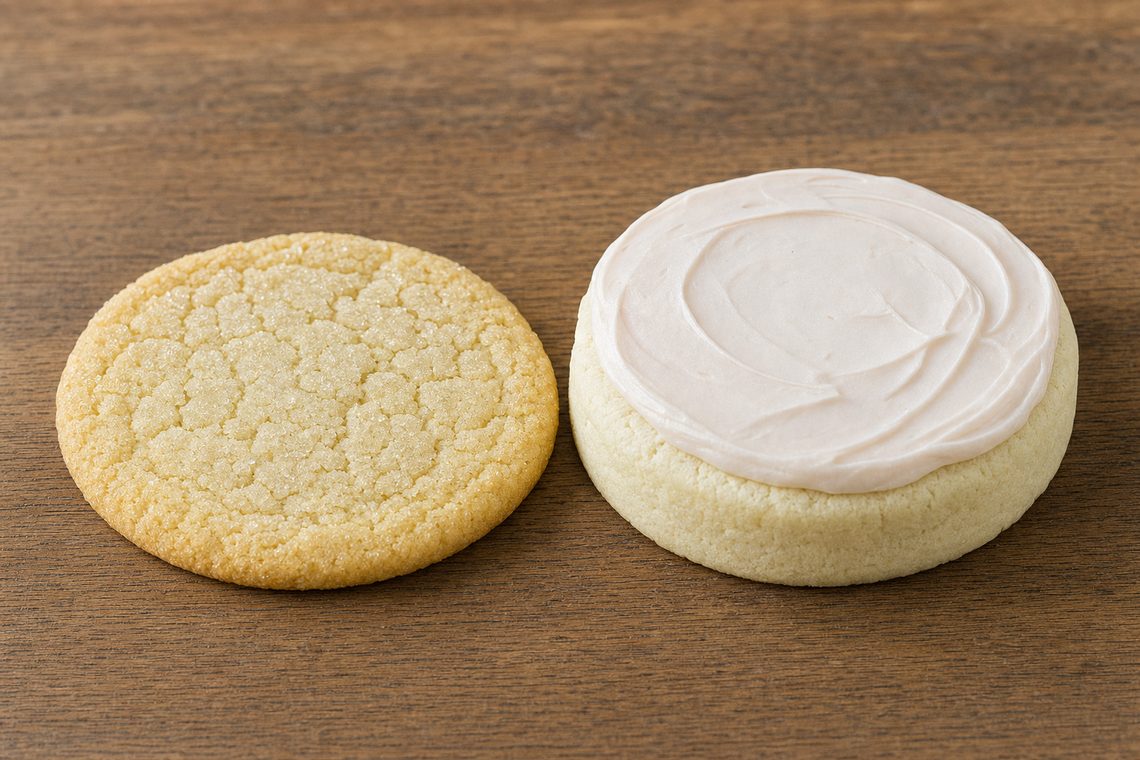
A thin crackled sugar cookie beside a thick pale frosted one.
Grammy's Kitchen · illustration
Pick your soft

How to get a soft sugar cookie

Two different cookies, and one habit that helps both.

If you want the classic 104 recipes

Pull it pale and early

The classic sugar cookie is soft because of when it left the oven, not because of what went in the bowl.

This cookie reads its clock by colour absence: take it out just-set and barely coloured, while the middle still looks undercommitted. Cooks who did that clustered around nine minutes. Leave it for colour and you have made the crisp version, which is a perfectly good cookie and a different one from what you asked for.

The tell: edges set, no real browning anywhere, centre still matte.

If you want the pillow 98 recipes

Build a Lofthouse instead of underbaking a classic

The thick, pale, frosted supermarket cookie is engineered not to spread, and you cannot get there by pulling a classic early.

It is a different formula: a softer flour or a little cornstarch standing in for the commercial cake flour, and cream of tartar, which this dish borrows knowingly from its snickerdoodle cousin. The frosting is not decoration on this one either, it is part of how it stays soft. Start from a recipe written for it rather than adapting one that was not.

Why it matters: the sugar level that looks like this dish's median is an average of the two modes and describes neither. Pick a mode, then follow it.

Either way three reports

Frost them and seal them, then judge tomorrow

These cookies soften overnight, which means a cookie that seems slightly overbaked tonight is often fine by morning.

Cooks reported sealed containers reading super-soft the next day, foil laid over the icing as a deliberate anti-hardening move, and slightly overbaked batches rescued simply by frosting and storing them. The icing donates moisture and the sealed box keeps it in the cookie. It is the one dish on this site where waiting is a technique.

The exception: an unfrosted classic stored naked almost certainly stales the ordinary way. Our cooks did not store them that way, so we cannot tell you how fast.
The pick

The soft, cakey one we would bake

Closest to the middle of the 98 recipes we measured as cakey, among those enough cooks have rated.

Sugar Cookies
Best of the thick, cakey group

Sugar Cookies

from tastesbetterfromscratch.com 4.81 242 cooks rated it

Ingredients

  • 2/3 cup butter or vegetable shortening* (or 1/3 cup butter and 1/3 cup shortening (123g))
  • 1 cup granulated sugar (200g)
  • 2 large eggs
  • 1/3 cup milk (83g)
  • 1 teaspoon vanilla extract (5 ml)
  • 1/4 teaspoon almond extract (optional, but makes a great flavor )
  • 3 cups all-purpose flour (375g)
  • 2 teaspoons baking powder (8 g)
  • 1 teaspoon salt (5 g)
  • 8 ounces cream cheese (softened (226 g))
  • 1/2 cup butter (softened, (113g))
  • 1 teaspoon vanilla extract (5 ml)
  • 3-4 cups powdered sugar (360-480g)

Method

  1. Mix shortening/butter and sugar In a mixing bowl until well creamed together. Add eggs, milk, and vanilla and mix.
  2. Dry Ingredients: In a separate bowl, mix dry ingredients--(flour, baking powder, and salt. Slowly mix dry ingredients into the wet mixture until you form a large dough ball. Add a little more flour, if needed, but not too much.
  3. Chill dough for at least 30 minutes in the fridge, or up to 3 days.
  4. Roll Out: Dust counter top with flour and roll dough ball out until 1/2 inch to 3/4 inch thick. (Add a little flour as needed to counter, rolling pin and top of dough, keep dough from sticking). Cut the dough into shapes with cookie cutters (or use a round drinking cup).
  5. Bake: Place cookies on a parchment lined baking sheet. Bake at 350 degrees F for about 7-10 minutes. Cookies will be very light colored and just set, when you take them out. They will harden as they cool, so don't over bake them.
  6. Frosting: Add butter and cream cheese to a mixing bowl and beat well until smooth and creamy. Add powdered sugar and vanilla. Add more powdered sugar, as needed, until the frosting is desired thickness. Beaet for several minutes until very smooth and soft. (Stir in food coloring if desired.)
  7. Frost cooled sugar cookies and top with sprinkles, if desired.
Straight with you

Where we would be guessing

So you know how far to trust the rest of this page.

Why we will not give you one sugar number

The median sugar level for this dish sits between two modes whose quartiles are miles apart, so it describes no real cookie. Quoting it would look more precise and be less true. That is why this page asks you to pick a mode first.

The softening result is cooks, not a trial

Three independent reports of cookies softening overnight, plus cooks using frosting and foil deliberately to that end. It is consistent and it is not something anyone ran as a controlled test, so treat it as a well-supported habit rather than a measurement.

We do not hold the icing

Frosting is doing real work in the Lofthouse story and our data is about doughs. We can tell you that sealing a frosted cookie keeps it soft; we cannot tell you which frosting, or how much.