The most recognisable thing about the cookie

Why do you press peanut butter cookies with a fork?

Because this dough is too dense for the oven to spread on its own. Skip the press and you get a tall mound with a raw middle. The criss-cross pattern is tradition; the flattening is not optional.

That distinction is the useful part. Cooks who used a meat mallet or the bottom of a glass got perfectly good cookies, and cooks who left the balls round reported dense underdone centres. Any flat thing will do the job. Nothing will not.

Read against 169 published peanut butter cookies recipes and 2,491 reports from cooks who changed one thing.

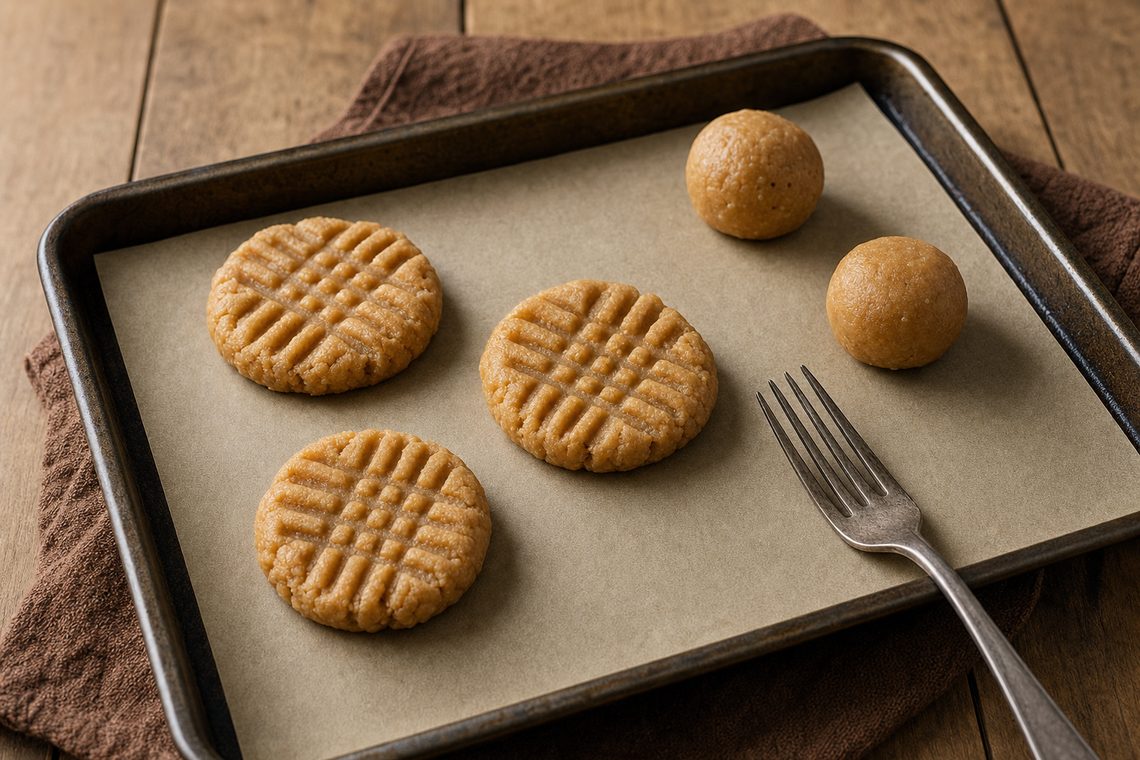
Peanut butter cookie dough balls on a tray, some pressed with a criss-cross fork pattern and some still round.
Grammy's Kitchen · illustration
Two explanations, one that holds

What the fork is actually doing

Do this

Press every ball flat before it bakes

Peanut butter makes a dense, stiff dough that will not relax and spread the way a butter dough does.

The fork does mechanically what the oven cannot: it pre-spreads the cookie so the heat has a thin enough section to cook through. Cooks who left the balls tall reported the worst centre and edge readings in the whole file, and cooks who simply forgot the step reported dense underdone middles twice over. If the dough sticks, dip the fork in sugar or flour between presses; that is an anti-stick trick, not chemistry.

Flourless versions need more: the doughs with no flour at all want a wet, sugared fork and two passes per ball.

Free choice

The criss-cross itself is tradition

The pattern signals what is in the cookie. It has no effect the flattening does not already have.

It is a real piece of history rather than a myth, and it is genuinely why the marks look the way they do. But cooks who flattened with a mallet, a glass or their palm got the same result. Use the fork because the cookie should look like a peanut butter cookie, not because the cookie needs it.

Worth knowing

This is the one cookie in the family you flatten

Every sibling dish says the opposite: leave the ball tall and let the oven decide.

Oatmeal cookies keep their shape best when nobody presses them, and snickerdoodles are the same story again. Peanut butter inverts it because the dough is stiff rather than slack, so pre-spending the spread is the only way it happens at all. If you have learned the ball-don't-flatten rule elsewhere on this site, this is where to put it down.
Straight with you

Where we would be guessing

So you know how far to trust the rest of this page.

Cook reports, not a controlled trial

Nobody baked one dough pressed and unpressed side by side and reported both. What we have is cooks describing tall mounds with raw middles, cooks who skipped the press and regretted it, and cooks who flattened by other means and did fine. They all point the same way, and that is agreement rather than an experiment.

Both explanations are true, they just answer different things

The historical account of the marks is real and we are not debunking it. It explains the PATTERN. It does not explain why the cookie needs flattening, and reading it as the whole answer is what makes people think the step is optional.

How flat is your judgement

We can tell you to flatten and why. How far to press depends on how big your ball is and how stiff your dough is, and nobody recorded that in a way we could compare.