Three thickeners, and you have spent one

Why is my gumbo thin?

Almost certainly because the roux went dark, which is what dark rouxs do. That is not a pot that failed — it is a pot with two unspent options left in it.

We compared 161 published gumbo recipes and read 3,299 reviews. 41 of those reviewers said something specific enough about the body to score it, and they sit low and wide: the median is 6 out of 10 and the bottom quarter is 3. Thin gumbo is common, and it is the most fixable thing on this page.

161Recipes compared
3,299Reviews read
41Sauce-body ratings
3–6Bottom quarter to median

Read against 161 published gumbo recipes and 3,299 reports from cooks who changed one thing.

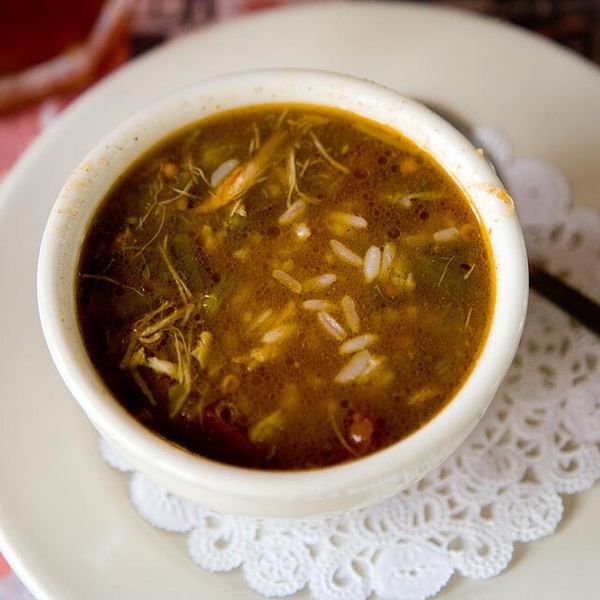
A small white bowl of thin, brothy gumbo with rice, on a saucer.
A gumbo that has not been thickened yet. The tin of filé is still on the table. Elliot · CC BY 2.0
The answer, first

Add a thickener, and be generous about it

Any of them works. What matters is that you pick one rather than simmering and hoping.

Tonight 9 cooks for, 2 against

Extra roux, okra, filé, or a spoonful of cornstarch

Any of the traditional thickeners — extra roux, okra (including steaming it in the hot roux first to cut slime), gumbo filé, or cornstarch — reliably thickens the gumbo to good body (5.5-9/10); the specific thickener matters less than using enough of it. Two failure modes stand out: doubling the roux with margarine at the stated 3/4-cup-fat-to-1-cup-flour ratio broke the gravy (1/10), and rice flour plus xanthan gum failed to thicken properly (2/10).

Nine cooks, landing between 5.5 and 9 out of 10, across four completely different substances. That breadth is the finding: this is not a dish with one correct thickener that you either used properly or did not. It is a dish with three independent systems, and a fourth borrowed from the store cupboard, all of which reach the same place.

Substituting cornstarch (about 2 Tbsp) for file powder when unavailable reliably reaches good sauce body (7-8/10).

2 cooks report this

What to do: filé is the fastest if you have it — off the heat, and do not let the pot boil afterwards. Cornstarch slurried into cold water is the one everybody already owns. Okra needs longer, so it is tomorrow's answer rather than tonight's.

Not this The worst scores in the corpus

Do not use less liquid next time

It is the obvious correction and it is the wrong one. The under-filled batches in our reading score the worst of anything here — you end up with a small amount of thick, over-concentrated, over-salted gumbo rather than a properly bodied pot.

Thin gumbo is a thickener problem wearing a water problem's clothes. The liquid is not the variable; what you put in to hold it together is. A gumbo made with the full quantity of stock and a proper amount of thickener is a different and better dish from one made with less of both.

What to do: keep the liquid where the recipe puts it and change the thickener instead.

Why this dish has options

Three thickeners, and none of them is gelatin

Every other braise on this site gets its body the same way: hours of low heat melt the connective tissue in the meat into gelatin, and the gelatin thickens the sauce. Gumbo cannot do that. Chicken thighs give up a little collagen, and cured sausage and shellfish give up essentially none — there is nothing in the pot to render. Body has to be put in.

So the dish carries three ways of putting it in, and they work by completely different chemistry, which is why one can cover for another:

Roux

Starch from flour. The only one that also brings flavour, and the only one that gets weaker the more you cook it.

Okra

Mucilage, released into the liquid over the simmer. Slower, and it brings its own texture question.

Filé

Mucilage from ground sassafras leaf, stirred in at the very end with the heat off. The only one you can add after you have seen how thick it is.

That is the practical reason a thin gumbo is not a ruined one. If the roux is already dark, its thickening is spent — but nothing you did to the roux affects what okra or filé can still do.

A note on how we know: 132 of these 161 recipes register a measurable thickener. Until this week that number was two, on exactly the same recipes — flour in a pot was being counted as the structure of a baked good rather than as a thickener, so the axis that measures gumbo's defining ingredient read zero. It is the single largest thing we have ever had wrong about this dish.
The other direction

And if you overshoot

One cook each way, so treat this as a direction rather than a measurement — but the direction makes sense and it is worth knowing before you reach for the tap. You are replacing volume, and volume in this dish is stock. Water dilutes everything else at the same time, which is how a correction becomes a second problem.

The measured layer

What 41 reviewers actually reported

Not modelled, not estimated. These are the scores people gave, and the bar is the middle half of them.

Sauce body (41 ratings)3–7, mid 6Depth of browning (64 ratings)5–8.5, mid 7Richness (20 ratings)7–8, mid 7.5
Reviewer ratings out of 10: the bar is the middle half of the scores and the line is the median.

Browning and richness both sit high — cooks are getting the flavour they came for. Body is the one that spreads downward, with a first quartile of 3 out of 10. This is a dish whose readers largely succeed at the hard part and then miss the part everybody assumes takes care of itself.

Where we would be guessing

What this page does not know

  • Nothing here is a fitted result. Every statistical test run on gumbo came back null, and the one control that would tell us the method works on this dish at all was never run. Everything above is chemistry and counted cooks.
  • The rescue reports are one or two cooks each once you get past the nine-cook headline. Cornstarch is two, filé-for-okra is one, roux-and-okra-for-filé is one. The direction they agree on is worth more than any of the individual scores.
  • The over-thick fix is one cook on each side. Tomato and broth recovering an 8.5 against water managing 2 is a single comparison by a single person.
  • Nobody has tested whether okra and filé really clash. The old rule says never both in one pot. Our chemistry review found no reason they should interfere and our cooks never run the comparison.
  • Half the corpus registers no salt at all, which is not the same as being unseasoned — the seasoning arrives as a commercial Cajun blend that our ingredient parser reads as spice rather than salt. It is why salt appears nowhere in the formulas on the hub page.