One pan, two accounts

How dark should a gumbo roux be?

Darker is not simply better. The browning that builds the flavour is the same heat that breaks down the starch doing the thickening, so the colour dial moves value from one to the other.

We compared 161 published gumbo recipes and read 3,299 reviews. The roux is the most-discussed decision in the dish by a distance — 33 cooks weigh in on it — and 64 reviewers scored the colour they got. Split those by where the roux was made and the answer is not the one the recipes give.

161Recipes compared
3,299Reviews read
33Cooks on the roux
64Browning ratings

Read against 161 published gumbo recipes and 3,299 reports from cooks who changed one thing.

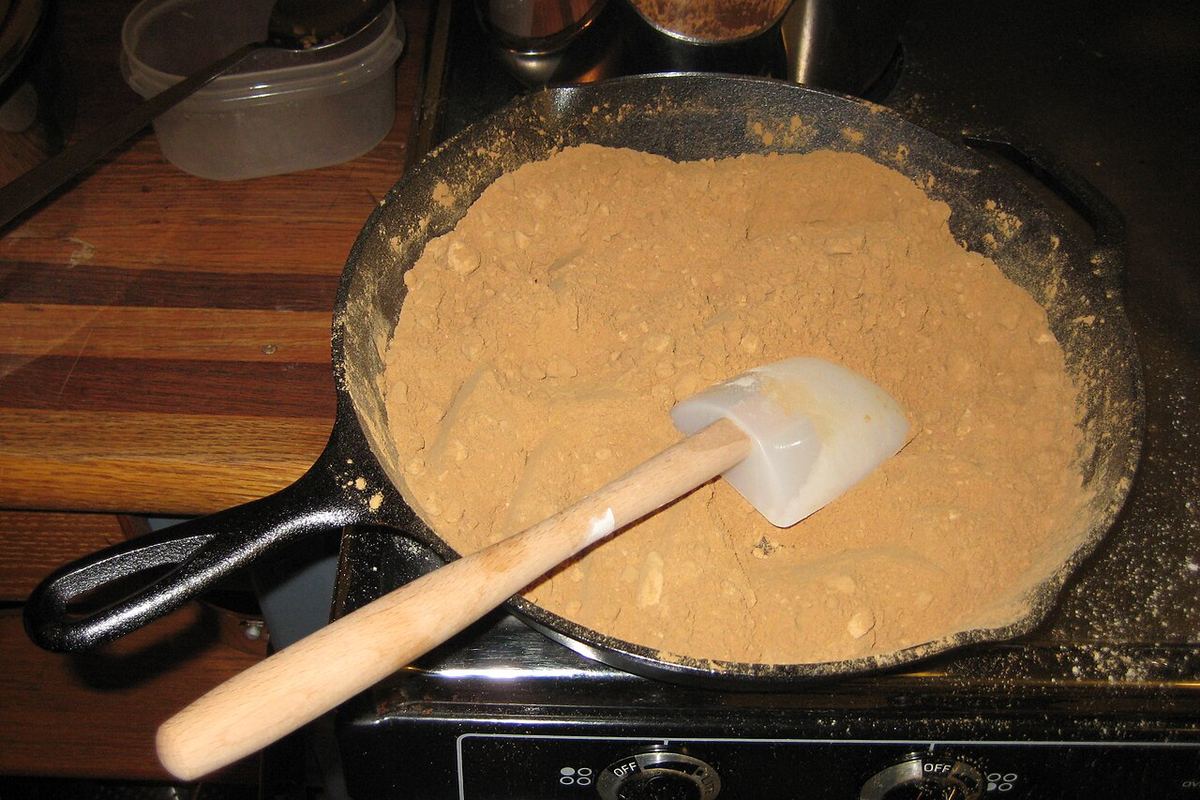
A cast-iron skillet holding a flat bed of toasted flour at peanut-butter colour, with a spatula resting in it.
A roux at peanut-butter colour. Everything past this point is a trade. JaseMan · CC BY 2.0
The answer, first

Make it in the oven, and decide the colour on purpose

Two decisions, and most recipes hand you neither.

The reliability play 7 cooks for, 1 against

The oven gets you darker with far less risk of losing it

Making the roux in the oven (dry-bake or oven-braise method) instead of stovetop stirring reliably reaches deep, dark color (7-8/10) with less risk of scorching than active stovetop stirring.

A stovetop roux is an hour of continuous attention in which one lapse ends the batch — the pan is hotter than the flour wants and the only thing between you and black specks is stirring. An oven surrounds it with even heat instead, so it browns on its own schedule and forgives you for answering the door. It is the same chemistry arriving with a much wider margin.

What to do: 300–350°F, stirred every twenty minutes or so, one to two hours. Or bake the flour dry with no fat at all and whisk the oil in afterwards, which two cooks rated 9 out of 10 for colour and is the fastest route of any.

The trade nobody prints Roughly a quarter of the thickening

Every shade darker costs you body

Flour thickens because its starch chains swell and tangle. Browning is those chains breaking apart — that is where the toasted flavour comes from. So the two are the same reaction seen from two sides, and you cannot have the maximum of both out of one pan. Dark-roux traditions answer this by using more flour, not by cooking it differently.

What to do: if you are going chocolate-dark, plan the body in advance — more flour to start, or okra or filé to finish. Do not simply double the roux at the end: one cook who did broke the gravy outright.

The finding

The same reviewers say the oven browns better and thickens worse

Which is what the chemistry predicts, arriving as two charts that point opposite ways.

64 reviewers scored the colour and 41 scored the body, and both can be split by where the recipe made its roux. If the trade above is real, the method that browns best should thicken worst. It does.

Depth of browning, by where the roux was made

Mean depth-of-browning rating by roux method, from 64 reviewer scores out of 10. The oven leads by a full point.

Sauce body, from the same reviewers

Mean sauce-body rating by roux method, from 41 reviewer scores out of 10. The order reverses: the oven sits below the hob.

Read the two together. The oven route wins the colour by a clear margin and gives back roughly half a point of body — the same ledger, moving in both directions, in scores from people who had no idea they were demonstrating anything. It is not proof; nobody ran a controlled test and the cells are small. It is the mechanism showing up where it should show up, which is the most a review corpus can offer.

Means from published-recipe reviews, not an experiment. Oven-roux recipes differ from stovetop ones in more than the roux, and the body chart rests on 28 scores in total.

The failure with no recovery

Burnt is not a shade of dark

This is the reason the oven route matters more than a convenience preference. Everything else in this dish can be corrected after the fact — thin can be thickened, thick can be thinned, bland can be seasoned. A scorched roux cannot. The bitterness goes through the whole pot and every recovery anybody in our reading attempted capped out well short: a microwaved replacement got no further than peanut-butter colour and scored 4.5 out of 10, and bottled browning sauce as a colour shortcut managed 3.

Ten minutes of flour and oil is the cheapest thing in the pot. If you see black specks, tip it out and start again — you will lose less time than you will spend being disappointed in the finished gumbo.

The obvious fix, and its limit

You cannot brute-force the body out of more roux

If a dark roux thickens less, the arithmetic seems simple: use more of it. The corpus is not encouraging about that.

Doubling the roux quantity reached only moderate sauce body (6/10) despite full satisfaction -- more roux alone doesn't guarantee proportionally thicker sauce.

1 cook report this

Two reports, both of cooks doing the obvious thing, and neither got what they were after — one reached a middling body despite being happy overall, the other broke the gravy. A roux is an emulsion as well as a thickener, and past a certain ratio of flour to fat it stops behaving like one.

The way out is the thing that makes gumbo unusual: it has two more thickeners that owe nothing to the roux.

Any of the traditional thickeners — extra roux, okra (including steaming it in the hot roux first to cut slime), gumbo filé, or cornstarch — reliably thickens the gumbo to good body (5.5-9/10); the specific thickener matters less than using enough of it. Two failure modes stand out: doubling the roux with margarine at the stated 3/4-cup-fat-to-1-cup-flour ratio broke the gravy (1/10), and rice flour plus xanthan gum failed to thicken properly (2/10).

9 cooks report this, 2 disagree

Nine cooks, two disagreeing, across extra roux, okra, filé and cornstarch. That is the most practical sentence in the dish — the body is recoverable from several directions, so spending the flour on flavour is a decision rather than a gamble.

Where we would be guessing

What this page does not know

  • The one-quarter figure is not a measurement. "A dark roux thickens about a quarter as well as a pale one" traces to Alton Brown by way of Wikipedia. The direction is not in doubt; the precision is not ours to give. There is also a very exact-sounding number circulating about this — a 35% thickening loss measured by lab equipment — which appears to be invented, and we do not repeat it.
  • We cannot see anybody's roux. "Chocolate" and "peanut butter" are words reviewers typed, not colours we measured. Two cooks using the same word may not have made the same roux.
  • The charts are means, not an experiment. Nobody made one gumbo three ways. Oven-roux recipes differ from stovetop ones in more than their roux, and the body chart rests on 28 scores in total against the browning chart's 64.
  • Nothing here is a fitted result. Every statistical test run on this dish came back null, and the one control that would tell us the method works on gumbo at all was never run. This page is chemistry and counted cooks.
  • The burn-recovery reports are one cook each. They agree with each other and with everything anyone has ever said about burnt roux, and they are still two people.