The popular answer, measured

Carnitas in a slow cooker

It is what most people use and it scores worst of the three vessels on tenderness. That is worth knowing before you start, and it is fixable.

51 of the 114 carnitas recipes we compared use a slow cooker — more than the oven and the pressure cooker together. Reading their reviewers against everyone else's, the pork comes out at 7.0 out of 10 for tenderness against 8.2 for an oven braise. And then there is the part nobody mentions: nothing evaporates in a sealed pot, and this is the one braise in the family that has to end dry.

51Slow-cooker recipes
79Tenderness ratings
7.0Slow cooker, out of 10
8.2Oven, out of 10

Read against 114 published carnitas recipes and 2,856 reports from cooks who changed one thing.

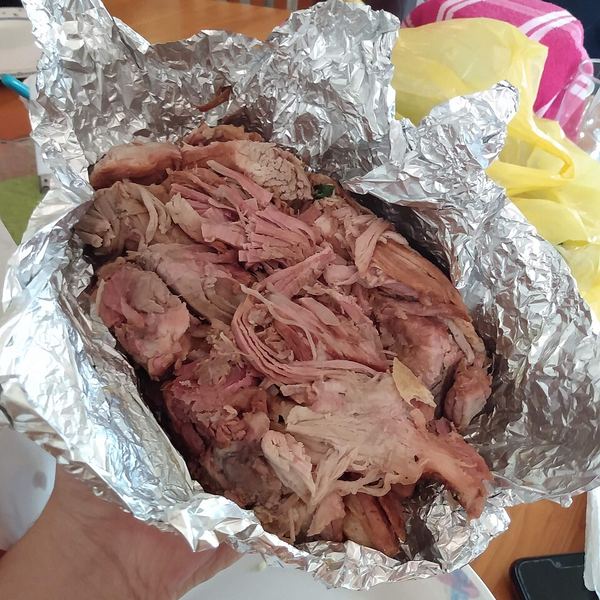
A kilo of shredded, pale cooked pork opened out on aluminium foil.
What comes out of the pot: tender, shredded, and not yet carnitas. ProtoplasmaKid · CC BY 4.0
The answer, first

Use it for the braise, and do the second half somewhere else

The machine is good at exactly one of this dish's two jobs, and it cannot do the other one at all.

What it cannot do The whole reason this dish is different

A sealed pot evaporates nothing, and carnitas has to end dry

Browning cannot start while there is liquid in the pan, because water holds the pan at its boiling point and colour needs a surface well above it. A slow cooker is sealed and runs below boiling, so the liquid you put in at 8am is still there at 6pm — plus whatever the pork rendered into it.

Every other braise in this family ends wet and is perfectly happy about it. This one does not. So the drain is not an optional tidy-up at the end, it is the step that makes the second half of the recipe possible, and it is the step slow-cooker recipes are most likely to gloss over.

Any active post-braise crisping step (pan-searing, air-frying, oven-baking at 400-450F, or broiling) reliably produces good browning (6-8/10) on shredded carnitas, regardless of which specific method is used.

What to do: tip the pot into a colander set over a bowl, spread the pork thin on a tray, and give it a broiler or a 400–450 °F oven for a few minutes. Keep the liquid: skim the fat off the top for the crisping, and reduce the rest into something to spoon over.

What it does well Shorter than the recipe says, and still fine

The braise clock is more elastic than the recipes admit

Cutting slow-cooker time down to 4-6 hours (instead of the standard 8-10) still reaches good tenderness (7-9/10) — the full stated cook time isn't strictly required.

Cooks who cut the standard eight-to-ten hours down to four to six still landed at 7 to 9 out of 10. That matters practically — it means the slow cooker is usable on an afternoon and not only on a whole day — and it matters for how you read the tenderness gap below. The pork is not failing because it needed longer.

What to do: start checking at four hours on low. It is done when it gives to a fork, which may be well before the recipe says.

The measured layer

The same reviewers, split by vessel

79 people scored the texture and 62 scored the colour. Only one of those charts has anything in it.

Tenderness — the slow cooker comes last

Mean tenderness rating by cooking vessel, from 79 reviewer scores out of 10. The oven and pressure cooker sit more than a point above the slow cooker.

Depth of browning — no difference at all

Mean depth-of-browning rating by cooking vessel, from 62 reviewer scores out of 10. The three vessels are within a third of a point of each other.

The second chart is the one that tells you what to do. Browning does not care what you braised in, because by the time you are browning, every vessel has handed you the same shredded pork on the same tray. So the slow cooker costs you nothing on colour — provided you take the pork out of it. What it costs is on the first chart.

Means from published-recipe reviews, not a controlled test. Nobody cooked one shoulder three ways, and slow-cooker recipes differ from oven recipes in more than their vessel — some of that gap belongs to those other differences.

Two things that go wrong here specifically

Both of them happen before you notice

Leaving it on "keep warm"

Leaving the pork on a slow cooker's "keep warm" setting for almost 2 hours before opening the pot dropped moistness to 1/10 in both duplicate reports.

2 cooks report this

This is the failure mode the vessel invites: the pork is done, you are not home, and the machine helpfully holds it. Nearly two hours of that before the lid came off dropped the moisture badly in both reports. If it has to wait, it is better off out of the pot and in the fridge — and re-crisping from cold is the one reheat that improves this dish.

Cubing and searing before it goes in

Cubing the meat and searing each side before slow cooking, instead of cooking it whole, dropped tenderness to 1/10 in both duplicate reports of the same modification -- the inverse of chili's cubed-meat sear, this pre-cutting appears to work against the slow, whole-piece collagen conversion carnitas depends on.

2 cooks report this

Searing the meat whole (not cubed) before slow cooking, then leaving it whole in the slow cooker, produced tenderness of 8/10 -- a useful contrast to searing cubed pieces before slow cooking, which cratered tenderness to 1/10.

1 cook report this

This is the one place carnitas contradicts what most of us were taught about braising. Cubing the pork and browning every face before the slow cooker dropped tenderness to 1 out of 10 in both reports that did it; searing it whole and leaving it whole was fine. Small pieces with a lot of exposed, already-contracted surface do not survive ten hours the way a single large piece does — and in this dish the browning you were trying to get belongs at the end anyway, where it is free.

The order of operations

What to do with the slow cooker in front of you

  1. Use less liquid than feels right. The median carnitas recipe in our corpus uses about a tenth of the meat's weight in liquid, and cooks whose pork sat at or below half its height still got it tender. Nothing is going to evaporate, and everything you add is something you will have to pour off later.
  2. Leave the pork in large pieces and do not sear it first. Both of those are the opposite of the usual braising advice and both are what this corpus reports.
  3. Low, and start checking at four hours. The recipe's eight to ten is a safe upper bound rather than a requirement.
  4. Do not let it sit on keep-warm. If you are not ready, take it out.
  5. Drain it, and keep what you drain. Colander over a bowl. Skim the fat for the next step; reduce the rest for the table.
  6. Shred it, spread it thin, and give it heat. A few minutes under a broiler. This is the step that turns very good pulled pork into carnitas, and it is the one the machine cannot do for you.
Where we would be guessing

What this page does not know

  • The vessel chart is means, not an experiment. Nobody cooked one shoulder three ways. Slow-cooker recipes differ from oven ones in more than the vessel, and some of the tenderness gap belongs to those other differences rather than to the machine.
  • The shorter-braise finding comes from satisfied cooks. Four to six hours instead of eight to ten is reported by people who wrote a recommending review. Anyone whose short braise failed did not write one, so read it as demonstrated for some cuts and sizes rather than safe for all.
  • We do not know which slow cooker. "Low" is not a temperature and machines run several degrees apart. No reviewer records a model or a wattage.
  • The two failure findings rest on two reports each. Keep-warm dryness and cube-then-sear both come from exactly two cooks who agree with each other. The mechanisms are sound; the scores are anecdotes with provenance.
  • Nothing on this page is a fitted result. The only statistical signal in this dish is salt against saltiness, which is a control rather than a discovery and is not used here.