The instruction everybody skips half of

Why your carnitas is not crispy

Because the pan was still wet. Nothing browns while there is liquid in it — not under a broiler, not in a skillet, not at any temperature you own.

We compared 114 published carnitas recipes and read 2,856 reviews. 62 of those reviewers said something specific enough about the colour to score it, and the agreement underneath is the strongest in this dish: 25 cooks report that adding some kind of crisping step at the end makes it browner, and not one reports otherwise.

114Recipes compared
2,856Reviews read
62Browning ratings
25Cooks for, none against

Read against 114 published carnitas recipes and 2,856 reports from cooks who changed one thing.

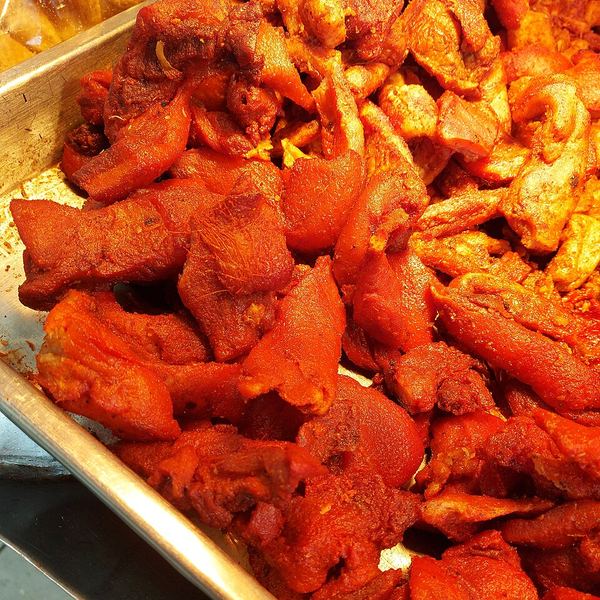
A large metal tray of carnitas, the pork deeply browned and glistening, cut into rough pieces.
What the second half of the cooking is for. DaliaMonge · CC BY-SA 4.0
The answer, first

Pour the liquid off, then apply heat — in that order

Two steps, and almost every page on this subject prints only the second one.

The step that is missing 3 cooks, converging from 3 directions

Get the pan down to half the meat's height or less

Broiling without added liquid, or pouring off cooking liquid so it sits at half the meat's height or less before crisping, raised depth of browning to 6-7/10.

Water boils at 212 °F and will not go past it, and a pan with liquid in it is pinned there until the liquid is gone. Browning does not begin until well above that. So while there is braising liquid in the tray, the surface of the pork is being steamed, however hot you set the oven — the energy is going into evaporating the liquid rather than into the meat.

The reassuring half is that the braise never wanted that liquid anyway. Cooks whose pork sat at or below half its height throughout still reported it perfectly tender. You are not trading tenderness for colour; you are pouring off something you did not need.

What to do: tip the pot into a colander over a bowl. Keep the liquid — it is worth reducing into a pour-over, and the fat you skim off it is the frying medium the next step wants.

Then any heat you like 25 cooks for, none against

Broiler, skillet, air fryer or a hot oven — they all work

Any active post-braise crisping step (pan-searing, air-frying, oven-baking at 400-450F, or broiling) reliably produces good browning (6-8/10) on shredded carnitas, regardless of which specific method is used.

This is the deepest agreement anywhere in this dish and it is notably unfussy about method. Pan-searing, air-frying, baking at 400–450 °F and broiling all produce it. What they have in common is dry heat on a surface that is no longer wet, which is the only variable that matters.

What to do: spread the shredded pork thin on a tray, give it room, and put it under the broiler for a few minutes. Stir once to turn new surfaces up and go again.

The finding

The vessel decides your meat. It has nothing to do with your crust.

Two questions people ask as one, which the same reviewers answer differently.

62 reviewers scored the colour and 79 scored the texture, and both can be split by what the recipe was cooked in. On colour the vessels are 0.3 of a point apart — which is to say identical. On tenderness they are 1.1 apart, and the most popular vessel in the corpus comes last.

Depth of browning, by vessel — flat

Mean depth-of-browning rating by cooking vessel, from 62 reviewer scores out of 10. The three vessels are within a third of a point of each other.

Tenderness, by the same vessels — not flat

Mean tenderness rating by cooking vessel, from 79 reviewer scores out of 10. The oven and the pressure cooker sit more than a point above the slow cooker.

That is the whole architecture of this dish in two charts. Browning is decided by a step you take at the end, and every vessel gets you to the same place because every one of them hands you the same shredded pork to crisp. Tenderness is decided by the braise, and there the vessels genuinely differ. Nobody needs advice about which pot browns better. Plenty of people could use knowing which one their pork came out of.

Means from published-recipe reviews, not a controlled test. Slow-cooker recipes differ from oven recipes in more than their vessel.

The diagnostic

Pale and tough are different failures

And the fixes have nothing to do with each other, which is why it matters which one you have.

Skipping the broiling/crisping step entirely still produced tenderness of 7-8/10 across two reports, confirming that tenderness is set by the braise phase and is unaffected by whether the second, dry crisping phase happens at all.

2 cooks report this

Read that carefully, because it is the most useful sentence on this page. Cooks who skipped the browning step altogether did not end up with tough pork. They ended up with tender pork that was the wrong colour — very good pulled pork that nobody would call carnitas. Tenderness and colour are bought with different currencies and neither one is refundable into the other.

Skipping the crisping/broiling step entirely and serving carnitas straight from the braising liquid or slow cooker leaves it visibly under-browned (2/10) rather than crisp-edged.

2 cooks report this
Tender but pale

You short-changed the second half. Drain it, spread it thin, and give it heat. Five minutes, and no amount of extra braising would ever have fixed it.

Brown but tough

You short-changed the first half. Put it back and give it more time. Crisping it harder makes this worse, not better.

The details that change the result

Three things worth getting right at the crisp

Break it up before, not after

Shredding the meat before broiling/crisping (rather than leaving it in large pieces) raised depth of browning to 8/10.

1 cook report this

Leaving the pork in 2-inch cubes instead of shredding before broiling dropped depth of browning to 3/10 (hunks too large to crisp well), but one cook who instead pan-fried unshredded chunks in hot oil on the stovetop still reached 8/10 -- the failure is specific to broiling large pieces, not to leaving meat unshredded in general.

1 cook report this, 1 disagree

Crust only forms on surfaces, so shredding multiplies how much of it you can make in the same few minutes. The two reports above are the same finding from both ends: shredded first scored 8 out of 10 for colour, left in two-inch cubes scored 3. The cubes were not too cold or too wet. They were too few faces.

Note the timing, because it reverses. Breaking the meat up late helps; cubing it and searing every side before the slow cooker dropped tenderness badly in both reports that tried it. Small at the crisp, large at the braise.

The fat does not have to be lard

Substituting oil, bacon fat, or a partial amount of reserved rendered fat for lard when crisping the meat still produces good browning (7-8/10) — the specific fat used matters less than the act of actively crisping.

4 cooks report this

Bacon fat or plain oil raised the browning to 7–8 out of 10 in the reports we read, the same range lard produced. Use lard if you have it and want the tradition; nothing here says to go and buy some. What the pan is doing at that moment is frying, and frying is not fussy about which fat.

Give it room

A crowded tray is the wet-pan problem in a different costume: the pork at the edges browns and the pork in the middle sits in the steam coming off its neighbours. If you are doubling the batch, use two trays. One cook who doubled to a 7.6 lb shoulder split it across two pans and it worked.

Where we would be guessing

What this page does not know

  • Nothing here is a fitted result. The only statistical signal that survives correction in this dish is salt against saltiness, which is a control rather than a discovery and is not on this page. Every number above is a count of cooks or a score somebody typed into a review.
  • Nobody has tested shredding against not shredding. The mechanism is straightforward and the two reports above point the same way, but no cook ran the comparison and told us. That is reasoning with a corroborating anecdote, not a measurement.
  • The browning cluster is deep and almost everything else is thin. 25 cooks with no dissent on the crisping step is why this page is more confident than most of ours. The details below it rest on two to four reports each.
  • The vessel charts are means, not an experiment. Nobody cooked one shoulder three ways. Some of the tenderness gap belongs to other differences between slow-cooker recipes and oven recipes.
  • We cannot see how long anyone crisped for. "Under the broiler until brown" is what the reports say, and browning is fast enough that the difference between good and burnt is a minute or two nobody records.