Two true things that disagree

Do you need lard for carnitas?

No — and the reason people insist on it is not superstition either. Both of those are worth ten minutes before you go looking for a tub.

We compared 114 published carnitas recipes and read 2,856 reviews. Cooks who used bacon fat or plain oil instead of lard reported browning at 7 to 8 out of 10 — the same range lard produced — and one who swapped bacon fat for vegetable oil rated the tenderness 8. Against that sits a real mechanism for the traditional method that a review corpus cannot test, and we will not pretend otherwise.

114Recipes compared
2,856Reviews read
62Browning ratings
2Actually use a fat bath

Read against 114 published carnitas recipes and 2,856 reports from cooks who changed one thing.

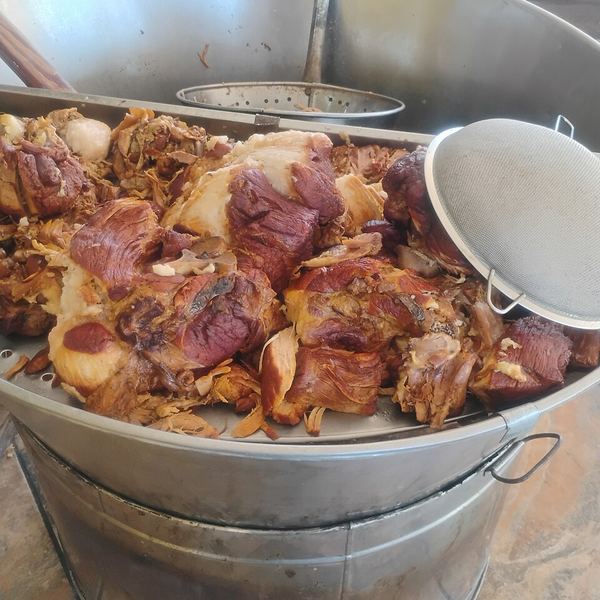
A very large shallow metal cazo full of pieces of pork cooking in fat, with a skimmer resting on the rim.
The traditional method: pork cooked submerged in its own fat in a cazo. Ferfive · CC BY 4.0
The answer, first

Use lard if you have it. Do not go and buy it.

The substitutions are well attested. What is not attested is that nothing is lost, and those are different claims.

What the cooks report 7 cooks across two clusters, none against

Bacon fat and plain oil browned just as well

Cooking in bacon fat or plain oil instead of lard consistently raised depth of browning to 7-8/10 across three reports.

Substituting oil, bacon fat, or a partial amount of reserved rendered fat for lard when crisping the meat still produces good browning (7-8/10) — the specific fat used matters less than the act of actively crisping.

This is the same pattern the rest of this family shows. The identity of what you pour in is close to free; the quantity and the level are what decide the result. What matters at the moment of the crisp is that there is hot fat and no water — and a fat is a fat for that purpose.

What to do: the fat the pork rendered is already in the pan. Skim it off the drained liquid and crisp in that. If you need more, use whatever is in the house.

What we cannot tell you Mechanism, not measurement

The case for a real fat bath is sound and untested

Cooking submerged in fat rather than in a water-based liquid should keep fat-soluble flavour compounds in the meat instead of dissolving them into something you later pour away. That is a genuine chemical argument for the traditional confit, not a story about authenticity.

It is also close to untestable from reviews. To measure it you would need cooks who made the same pork both ways and said which was better, and almost nobody does that — you commit to a method at the start of a four-hour cook. So the honest position is narrow: we can tell you substituting works. We cannot tell you nothing is lost.

What to do: if you want the tradition, do it properly — enough fat to cover, and keep it, because it is reusable and that is the historical reason the method exists.

A finding about the recipes, not the dish

Almost nobody publishes the traditional method

Of the 114 carnitas recipes we hold, 2 cook the pork genuinely submerged in fat — measured in pounds or gallons rather than quarter-cups. Between them those two carry a handful of ratings. Every widely reviewed carnitas recipe in English is a braise with a crisping step, not a confit.

That is worth saying out loud for two reasons. The first is practical: if you have read that carnitas is "pork confit" and then followed a recipe that uses a quarter-cup of lard in a slow cooker, those are not the same dish and the recipe is not wrong — it is the version the English-language web actually cooks. The second is about this site. Our own lard-confit destination has no published match and says so on the hub rather than electing a slow-cooker recipe with a spoonful of lard in it and calling that the tradition.

Counted from the ingredient lists at build time: a lard quantity in pounds, gallons or "for frying" reads as a fat bath; a quarter-cup reads as a frying fat.

The fat you already have

A shoulder brings its own, and where it ends up matters

Losing the pork's rendered fat to the cooking liquid (rather than it staying with the meat, e.g. via a freezer-bag leak) drops richness sharply (2/10); cooks who kept fat on the meat or added rendered fat back land at 6-7/10.

3 cooks report this, 1 disagree

The pork renders a great deal of fat during the braise, and the question is whether it stays with the meat or ends up in the liquid you pour off. That is the one place in this dish where fat clearly does something a reader can act on, and the action is simple: skim the drained liquid and put that fat back at the crisp. It is free, it is already seasoned with everything else in the pot, and it is exactly the frying medium the second half of the recipe wants.

Using a well-marbled pork butt and adding back only partial rendered fat raised richness to 6-7/10.

2 cooks report this

The marbling question is less settled than we expected. Our own chemistry write-up predicted that a well-marbled, fat-capped butt would draw fewer complaints about dryness than a trimmed lean cut. The cooks do not show that. What they show instead is the more useful negative:

Leaner cuts substituted for the standard shoulder/butt (pork loin, tenderloin, or country ribs) still crisp and brown well (7/10) with the same post-braise treatment.

3 cooks report this

Leaner cuts — loin, tenderloin, country ribs — still crisped and browned successfully. They need fat added, because they will not supply their own, and their braise window is shorter. But the fat cap is not the gatekeeper this dish is often said to have.
Where we would be guessing

What this page does not know

  • The central claim on this page cannot be tested by reading reviews. Whether a fat medium keeps flavour in the meat where a watery one leaches it out needs somebody to cook the same pork both ways and say which was better. Nobody does. A blind comparison graded on flavour rather than on browning would settle it in an afternoon.
  • We could not confirm that a fattier cut is more forgiving. Our write-up predicted it and the corpus does not deliver the contrast either way. The advice is written to the weaker conclusion.
  • The substitution reports are seven cooks, not seventy. They agree with each other and with the mechanism, and they are still seven cooks. Trust the direction ahead of any individual score out of ten.
  • Nothing here is a fitted result. The only statistical signal in this dish is salt against saltiness, which is a control rather than a discovery and has nothing to do with fat.
  • We have not tested reused fat. The historical case for the confit is partly that the lard keeps and gets better. No reviewer in our corpus is on their second batch.