A question with two right answers

My beef stew is too thin

Every other page answers this with a cornstarch slurry. A third of the cooks we read think that is the wrong move, and they are not wrong either.

We compared 162 published beef stew recipes and read 3,347 reviews. 108 of those reviewers said something specific enough about the sauce to score it, and they do not cluster around "about right": the median is 7 out of 10 and the bottom quarter sits at 4. People are getting stew or they are getting soup, with not a lot in between.

162Recipes compared
3,347Reviews read
108Sauce-body ratings
4–7Bottom quarter to median

Read against 162 published beef stew recipes and 3,347 reports from cooks who changed one thing.

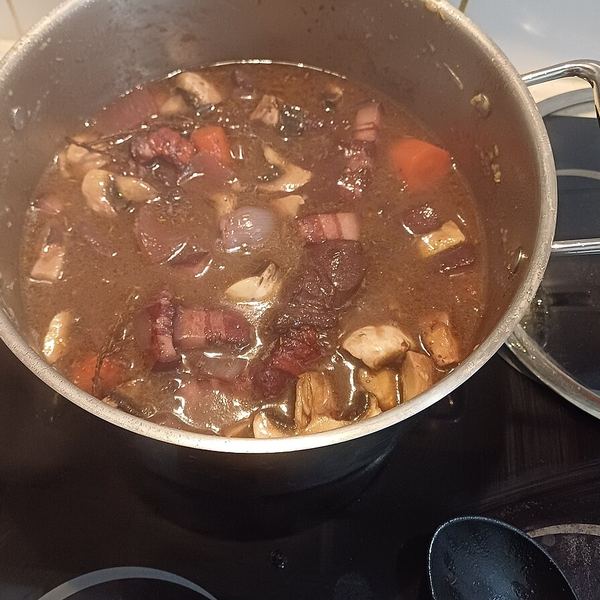
A pot of beef stew part-way through cooking, the liquid thin and clear rather than thickened, with beef, bacon and mushrooms in it.
A stew that has had no slurry and is not going to get one. Guislin · CC BY 4.0
The answer, first

Reduce it before you thicken it — then decide whether to thicken it at all

Two things are true at once here, and most pages only print the first one.

Do this first Free, and it cannot go wrong

Take the lid off and let it boil down

Reduction costs you nothing but time, and unlike a slurry it concentrates the flavour while it thickens. It is also the only correction that cannot be overdone in a way you cannot walk back — you can always stop.

Remember two things have already thickened it before you started. If the recipe dredged the beef in flour before searing, that flour is in the liquid now. If there are potatoes in the pot, their starch is too. Cooks who cut the broth and let the potatoes do the work rated the body 6 out of 10 with no added thickener at all, and starchy russets in big chunks — which fall apart into the liquid — reached 8.

What to do: uncover it for the last twenty to thirty minutes and see where it gets to. Then judge.

The contested part 11 cooks for, 5 against

A slurry at the end works, and a third of the people who use one wish they had not

Finishing with a flour or cornstarch slurry (or building a roux) noticeably thickens the sauce; cooks who skipped or forgot the flour step still reported an acceptable, just thinner, gravy.

This is the one question in beef stew where our cooks genuinely split, and we are not going to average them into a verdict. The objection is not that slurries fail to thicken — they obviously do. It is that the result tastes pasty and mutes the braise, which is a complaint about what a stew should taste like rather than about whether a technique works. Four cooks skipped the step entirely, by accident or by judgement, and reported a good stew.

Skipping the thickening step entirely (forgetting the flour, or judging it unnecessary) still produced decent body for some cooks (6-7/10), but for others left the stew clearly thin (2-3/10) -- whether a recipe's other ingredients (tomato paste, potato starch) carry enough body on their own is inconsistent across recipes.

What to do: if you thicken, undershoot. Every dissent in this corpus is about too much, never about too little, and you can always add more.
The finding

What you cooked it in decides this, and it does not decide tenderness

Two questions people ask together, which the evidence separates cleanly.

108 reviewers scored the sauce and 98 scored the meat, and we can split both by the vessel the recipe used. The two charts do not look alike. On the sauce the four vessels are 1.7 of a point apart, in the order an open pot beats a sealed one. On the meat they are 0.5 of a point apart — which is to say every vessel here gets you tender beef, and only one of them reliably gets you a sauce.

Sauce body, by vessel

Mean sauce-body rating by cooking vessel, from 108 reviewer scores out of 10.

Tenderness, by the same vessels

Mean tenderness rating by cooking vessel, from 98 reviewer scores out of 10.

The mechanism is not subtle. An open oven or stovetop braise loses water for hours and the sauce concentrates as it goes; a slow cooker and a pressure cooker are sealed, so whatever liquid you put in is still there at the end. That is the whole difference, and it is why the advice on this page changes depending on your answer to one question you already know.

Oven or stovetop

You have reduction working for you. Uncover it at the end and there is a good chance you need nothing else.

Slow cooker or pressure cooker

Nothing evaporated. Plan to finish it uncovered on the hob, or to thicken — starting with less liquid is the other way, and it is harder to judge in advance.

If you are going to thicken it

Three ways, and what separates the good reports from the bad

The spread inside each of these is wider than the gap between them, which is the useful part.

Cornstarch slurry

A cornstarch-and-water slurry reliably thickens the sauce (support: 8-9/10 body in six reports), but the same technique also produced thin, watery results for several other cooks (1-3/10) -- clumping, under-dissolving, or adding it too early/late likely separates the successes from the failures, since the ingredient list alone can't explain a 1-vs-9 spread.

8 cooks report this, 5 disagree

Read that spread again: the same technique produced 8 and 9 out of 10 for six cooks and 1 to 3 out of 10 for several others. An ingredient list cannot explain a result that lands at both ends of the scale, so something in the doing separates them — cornstarch that went in dry and clumped, or that never came to a proper simmer afterwards, or that was added early and cooked until it thinned back out. Whisk it into cold water first, add it to liquid that is actually bubbling, and give it two or three minutes.

Flour slurry or a roux

Thickening at the end with a flour slurry or a flour-and-fat roux (butter or oil) reliably built good sauce body (7-8/10 in most reports), though two cooks who added plain flour/water without building a proper roux got noticeably thinner results (4/10).

7 cooks report this, 2 disagree

Note what separates the 7s and 8s from the 4s: the cooks who built a proper roux — flour cooked in fat — did better than the cooks who stirred raw flour into water. Flour needs the fat to disperse and the heat to lose its raw taste; cornstarch does not. If you are using flour, use butter or the fat already in the pot.

The potatoes

Cutting broth and letting the potatoes' own starch thicken the stew naturally gave decent body (6/10) without any added thickener, and separately, using starchy russet potatoes in large chunks (which disintegrate into the liquid) produced very good body (8/10) -- potato starch is a real, if less controllable, thickening substrate.

2 cooks report this

The least controllable of the three and the only one that costs nothing. Cut some of the potatoes small enough that they break down and leave the rest in big pieces, and you get body and intact vegetables from the same ingredient. Waxy potatoes will not do this; that is what they are bred not to do.

Where we disagree with ourselves

More liquid: our numbers and our cooks point opposite ways

This is the honest state of the evidence and we would rather print it than pick the half we like.

Adding extra liquid (water or broth) beyond the recipe amount usually thinned the sauce as expected (values of 1, 3, 3, 3, 4, 4 out of 10 across six reports), but in three other reports the sauce stayed thick despite the added liquid (7-9/10) -- total reduction time and how much was added evidently matter more than the simple presence of extra liquid.

6 cooks report this, 4 disagree

Against that, our own fitted model of 25 within-recipe comparisons finds more braising liquid going with a higher sauce-body score (q = 0.0004). A within-recipe comparison is the harder one to explain away: it is the same recipe, cooked by different people, some of whom added liquid. If it were simply that wetter recipes happen to be better recipes, this fit should not survive.

Diluting the stock ratio with more water -- fewer bouillon cubes, half broth/half water -- without upping the thickener leaves the sauce noticeably thinner; a modest splash of extra liquid alone doesn't thin it as much.

3 cooks report this, 3 disagree

The most likely reconciliation, and it is a hypothesis rather than a result: total reduction time matters more than the volume that went in, so a cook who adds a cup and then simmers it away is not doing what a cook who adds a cup at the end is doing. Our data cannot separate those two, because nobody records how long they reduced. A controlled test would clear it up in an afternoon, and it is the single most useful test anybody could run on this dish.

Until then: correct thickness by reducing rather than by adding, which is the direction every line of evidence here agrees is safe.

The measured layer

What 108 reviewers actually reported

Not modelled, not estimated. These are the scores people gave, and the bar is the middle half of them.

Sauce body (108 ratings)4–8, mid 7Tenderness (98 ratings)8–9, mid 8Richness (65 ratings)7–8, mid 8
Reviewer ratings out of 10: the bar is the middle half of the scores and the line is the median.

Tenderness and richness both sit high and tight — most people get those right without help. Sauce body is the one that spreads, and it spreads downward. That is the argument for this page existing and it is also the reason the fix engine on the hub puts the sauce first.

Where we would be guessing

What this page does not know

  • We do not tell you whether to thicken. That is deliberate. Our cooks are 11 for and 5 against on slurries generally, 8 and 5 on cornstarch, 7 and 2 on flour, and 4 skipped it and were happy. Printing the majority as the answer would be dressing a preference up as a fact.
  • Our numbers and our cooks disagree about liquid and we have not resolved it. Both are above, in full.
  • The potato-starch route rests on two reports. The mechanism is sound and the direction is almost certainly right; the scores attached to it are two people's opinions.
  • Nobody records reduction time, which is very likely the variable doing the work in half of this. Every recipe says "simmer until tender" and no reviewer says how long they actually went.
  • The vessel charts are means, not experiments. Nobody cooked the same stew four ways. Oven recipes and slow-cooker recipes differ in more than their vessel, and some of that gap will belong to those other differences.