A trade, not a compromise

Beef stew in a slow cooker

It gets you the same tender beef as an oven braise and a noticeably thinner sauce, for one reason nobody mentions: nothing evaporates in a sealed pot.

43 of the 162 beef stew recipes we compared are slow-cooker recipes. Reading their reviewers against everybody else's, the meat scores 7.5 out of 10 — statistically indistinguishable from an oven braise — while the sauce scores 5.4 against the oven's 6.8. One of those gaps is worth knowing about before you start.

43Slow-cooker recipes
7.5Tenderness, out of 10
5.4Sauce body, out of 10
2If you use high

Read against 162 published beef stew recipes and 3,347 reports from cooks who changed one thing.

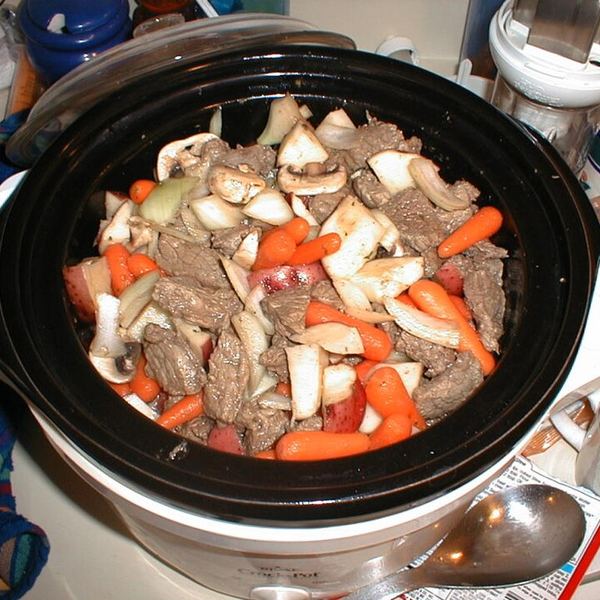
A slow cooker filled with cubes of beef, carrots, onion and mushrooms, before cooking.
Everything in the pot. The setting you choose next is the decision that matters most. Kurt Nordstrom from Ponder, TX, USA · CC BY 2.0
The answer, first

Low, always — and plan to finish the sauce yourself

Two decisions. One of them is the biggest single mistake anybody makes in this dish.

Do not use high 2 out of 10, in both reports

High is not a faster low

Cooking on the slow cooker's high setting instead of low badly hurt tenderness (2/10 in both reports that tried it) -- low-and-slow is not interchangeable with high-and-fast for this dish.

Every recipe on the internet prints "8 hours on low or 4 hours on high" as though those were two routes to the same dinner. In our reading they are not. Six cooks on low rated the beef 8 or 9 out of 10; the two who tried high rated it 2. Connective tissue needs time at a moderate temperature to turn into gelatin. Push the temperature up and the muscle fibres contract and wring out their moisture faster than the tissue softens, so you arrive at dinner with beef that is tough and dry at once — the two failures people usually think of as opposites.

Using a slow cooker/crock pot on its low setting (including transferring to one after browning) reliably produced very good to excellent tenderness (8-9/10) across six independent reports.

What to do: low, and start earlier. If it is already on high, turn it down now rather than shortening the cook.

The known cost 5.4 against the oven's 6.8

Nothing evaporates, so the sauce arrives thin

An oven or stovetop braise spends hours losing water, and the sauce concentrates as it goes. A slow cooker has a lid that seals and a temperature below boiling: whatever liquid you put in at 8am is still there at 6pm, plus whatever the meat and vegetables gave up.

This is not a flaw in the machine, it is what the machine is for — the same seal is why the meat never dries out and why you can leave the house. It just means the reduction step other methods do for free has to happen somewhere else.

What to do: pick one. Either tip it into a wide pan and boil it hard for ten minutes at the end, or thicken it — and undershoot, because every objection to thickening in this corpus is about too much. Starting with less liquid is the third option and the hardest to judge in advance.

Switching from stovetop/oven braising to a slow cooker or crockpot yields very tender meat.

5 cooks report this
The measured layer

The same reviewers, split by vessel

98 people scored the meat and 108 scored the sauce. The two charts do not look alike, and that is the whole story.

Tenderness — the slow cooker holds its own

Mean tenderness rating by cooking vessel, from 98 reviewer scores out of 10. The four vessels sit within half a point of each other.

Sauce body — and here it does not

Mean sauce-body rating by cooking vessel, from 108 reviewer scores out of 10. The sealed vessels sit well below the open ones.

Read down the two charts and the order is not the same. On the meat the vessels are interchangeable. On the sauce they line up almost exactly by how much water they let out — oven, then stovetop, then the two sealed vessels. That is a mechanism showing up in reviewer scores, which is about as good as evidence gets from a corpus nobody ran as an experiment.

Means from published-recipe reviews, not a controlled test. Nobody cooked one stew four ways; slow-cooker recipes differ from oven recipes in more than their vessel, and some of the gap belongs to those other differences.

The argument against

Plenty of people get a good sauce out of a slow cooker

Cooking in a crock pot alone gave a thin result for one cook (4/10), but three other reports of crockpot use (including transferring to one after stovetop simmering) all landed at decent body (7/10) -- the sealed-vessel/no-reduction concern the parent braise doc raises doesn't reliably show up as a problem here.

2 cooks report this, 3 disagree

We are printing this because it cuts against the finding above and because it is probably right about something. A slow-cooker stew that is already carrying a flour dredge, a can of tomatoes and a few starchy potatoes has three sources of body working before evaporation is even in the conversation. The averages say the sealed vessel starts you further back; they do not say you cannot get there.

Cutting broth and letting the potatoes' own starch thicken the stew naturally gave decent body (6/10) without any added thickener, and separately, using starchy russet potatoes in large chunks (which disintegrate into the liquid) produced very good body (8/10) -- potato starch is a real, if less controllable, thickening substrate.

2 cooks report this

The potatoes are the cheapest route and the one that suits this vessel best, because it needs no extra step at the end. Cut some of them small enough to fall apart and leave the rest in big pieces, and use a starchy potato — a waxy one is bred not to do this.

The order of operations

What to do with the slow cooker in front of you

  1. Brown the beef in a skillet first, in batches. The one thing a slow cooker cannot do is the sear, and seven cooks in this corpus agree on the same instruction with nobody dissenting: smaller batches so the pan is not crowded, and leave it alone rather than stirring. It is the twenty minutes that decides whether the stew tastes braised or boiled.
  2. Deglaze the skillet and pour that in too. Everything worth having from the browning is stuck to that pan.
  3. Use less liquid than a stovetop recipe would. Nothing is going to leave. If you are adapting an oven recipe, take out a cup.
  4. Root vegetables can go in at the start here. That is the one scheduling problem this vessel solves rather than creates — the temperature is low enough that carrots and potatoes hold their shape over a long cook instead of collapsing.
  5. Low. Eight hours or so. See above.
  6. Fix the sauce at the end, by reducing it in a wide pan or with a slurry, and taste for salt afterwards — a thin sauce and an under-salted one taste alarmingly similar.
Where we would be guessing

What this page does not know

  • The vessel charts are means, not an experiment. Nobody cooked the same stew four ways. Some of the sauce-body gap belongs to other differences between slow-cooker recipes and oven recipes.
  • The high-setting finding rests on two reports. They agree exactly and the mechanism explains them, and it is still two people. We lead with it because being wrong about it costs a reader nothing.
  • We do not know which slow cooker. "Low" is not a temperature and different machines run several degrees apart. No reviewer records a model, a wattage or a lid fit.
  • Nobody records how long they reduced. Which is very likely the variable doing the work in half of the sauce-body evidence on this site.
  • We do not settle whether to thicken. Our cooks are 11 for and 5 against on slurries, and the hub page argues that out rather than picking a side.