Two populations, not one

Why is my chili thin?

Almost every answer to this starts with "simmer it longer." In our reading that is both the most expensive fix available and rarely the actual cause.

We compared 171 published chili recipes and read 2,859 reviews. 33 of those reviewers said something specific enough about the sauce to score it -- and they do not cluster around "about right". The median score is 7 out of 10, but the bottom quarter sits at 2. People are getting chili or they are getting soup, with not much in between.

171Recipes compared
2,859Reviews read
33Sauce-body ratings
2–7Bottom quarter to median

Read against 171 published chili recipes and 2,859 reports from cooks who changed one thing.

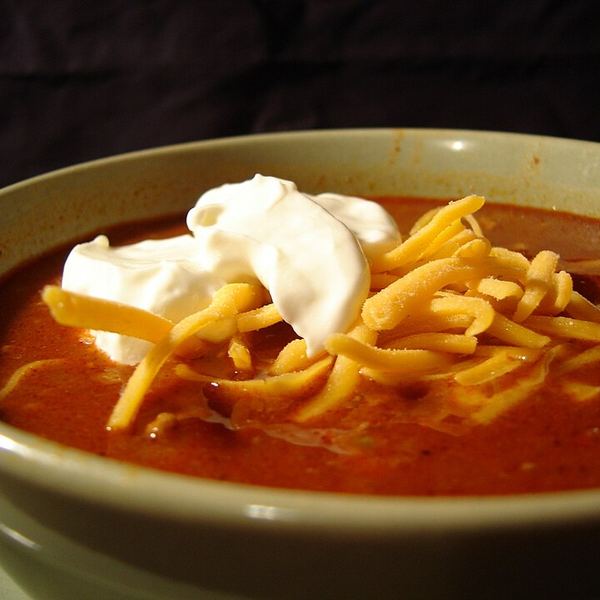
A bowl of thick chili topped with sour cream and cheese, the sauce clearly coating rather than pooling.
The target: a sauce that coats rather than pools. Andy Melton from Lancing, TN, USA · CC BY-SA 2.0
The answer, first

Check the tomatoes before you check the clock

The form of your tomato sets the floor your sauce starts from. Simmering is how you climb out of a hole you did not need to be in.

The biggest single lever 3 cooks for, 1 against

Diced tomatoes make a thinner chili than crushed or pureed

Using diced tomatoes in place of crushed or pureed tomatoes tends to leave the chili with a thinner sauce body than the original form calls for; fire-roasted diced tomatoes in a larger volume, or diced-plus-paste, can still deliver good body.

Diced tomatoes are held in their own juice and cut to stay in cubes, so they contribute liquid and very little body. Crushed and pureed have already been broken down, and that pulp is what makes a sauce cling. One cook using fire-roasted diced scored the body at 2 out of 10. Another, using the same fire-roasted diced but a full 30 oz can — noticeably more than the recipe asked for — reached 8 out of 10. Same product, opposite results: form sets the floor, and quantity is how you climb out of it.

What to do: use crushed or pureed tomato as the base. If diced is what you have, use appreciably more of it than the recipe says, or add a couple of spoons of tomato paste — one cook mixing diced with paste landed at 7 out of 10.

The expensive fix

Simmering longer works, and the beef pays for it

Failing to reduce the broth leaves the sauce noticeably thin — one cook scored it 2 out of 10 and rated the recipe one star. So reduction is real. It is just not free.

In a pot roast, a long braise is doing two jobs at once: concentrating the sauce and slowly converting tough connective tissue into gelatin. Ground beef has been through a grinder, so that second job does not exist — there is no collagen left to convert. The simmer is only thickening the sauce, and every minute of it is drying out the meat with nothing coming back. That is why "just simmer it longer" is a worse answer for chili than it is for almost any other braise, and why dry, grainy beef and a thick sauce so often arrive together.

What to do: reduce for flavour, not for thickness. Get the concentration you want, then stop and thicken with starch — which costs the meat nothing.

The cheap fix

Beans and masa thicken in minutes and cost the meat nothing

A mechanism the braise family does not otherwise have.

Reduction and gelatin are the two ways a braise usually gains body. Chili has a third that most of the family lacks: starch. Bean and masa starch granules swell as they heat, burst, and release amylose into the liquid, which thickens it directly. It happens in minutes, it does not depend on evaporation, and crucially it does not require any more time in the pot for the beef.

Mashing/using refried beans, or doubling the beans partway through the simmer so they absorb liquid, thickens the sauce body to 7-9/10 -- consistent with starch-gelatinization thickening from bean mass.

2 cooks report this

The corpus reports it working from both directions. Mashing or using refried beans thickens the sauce, and so does doubling the bean load partway through the simmer so the extra beans soak up liquid. Going the other way, using fewer beans than called for (less than 2 cans for 1 lb of meat) thinned the sauce body to 5/10.

The one way to get this wrong is timing and method. Masa or cornmeal sprinkled dry into a hot pot clumps: the outside of each lump gelatinises instantly and seals the middle, which never hydrates. Mix it with cold water into a slurry first, and add it in the last twenty minutes so it has time to thicken but not to taste raw.

What reviewers actually scored

Body is the widest miss of the three

Each bar is the middle half of real ratings, with the median marked. Wider means less predictable.

Sauce body (33 ratings)2–8, mid 7Richness (63 ratings)7–8, mid 7Heat level (88 ratings)4–7, mid 5
What reviewers actually scored, as ranges. Sauce body is the widest and lowest-sitting of the three: its middle half runs from 2 to 8 out of 10, against heat which holds between 4 and 7. Body is the outcome cooks are least able to hit on purpose.

Heat sits in a narrow band, and richness not much wider. Sauce body sprawls from one end of the scale to the other — which is the whole reason this page exists. It is the outcome people are least able to hit on purpose, and the one every recipe gives the least guidance on.

Deliberately not shown: a scatter of all 171 recipes. We hold a modelled body score for every recipe, but only 33 reviewers ever scored the sauce themselves. Plotting the model against the ratio it was computed from makes a beautiful chart that proves nothing, so these are the real ratings instead.

What we measured, and how far it goes

The numbers point the obvious way and no further

Two fitted signals in this dish touch sauce body, and both say what you would guess. Adding liquid within a recipe moves body (observed across 52 modifications), and recipes carrying more vegetable — which for chili mostly means tomato and beans — tend to have more body (25 recipes). We use those for direction only. The samples are small and the coefficients are far too fragile to turn into "add X and gain Y", so we do not.

Where it was cookedRatingsAverage body
Slow cooker77.0 / 10
Dutch oven66.7 / 10
Stovetop, uncovered205.0 / 10

An oddity we are not going to smooth over: the slow cooker scores highest here, despite being the one vessel that evaporates nothing at all. That is on a handful of ratings and could easily be noise, or it could be that people who reach for a slow cooker also start with less liquid. We do not know, and it is too small a sample to build advice on.

Where we would be guessing

What this page cannot tell you

  • We have no controlled test of tomato form. The claim rests on 33 scored reviews and the cooks' own reports, not on anyone cooking the same chili twice with the tomato swapped. It is consistent and it has a clear mechanism, but it is not proof.
  • The reduction cost to the meat is reasoned, not measured. Nobody who simmered for four hours and got dry beef wrote a review blaming the clock, so the corpus cannot see the price we say you are paying. That comes from the dish's mechanism doc, and if it is wrong, our advice to stop reducing early is wrong with it.
  • Most of these reports are one or two cooks deep. Trust the direction they point well ahead of any single score out of ten — those are individual opinions with a name attached, not measurements.
  • Dried beans are barely represented. Nearly everyone here used canned, so if you are cooking dried beans in an acidic pot, this page does not cover the way that changes the timing.